Top 15 Team-Building Problem-Solving Activities to Strengthen Your Team
Team-building problem-solving activities is essential for fostering collaboration, improving communication, and developing problem-solving skills within a group. Problem-solving activities take team building a step further by challenging participants to think critically, work together under pressure, and come up with creative solutions. Whether your team is remote or in-person, these activities can significantly enhance your team’s problem-solving capabilities while providing a fun and engaging experience.
Below you’ll find 15 activities, a handful of quick exercises you can run in a regular meeting, and a few simple techniques to pair with them. Looking for games your remote team can play together right now? Browse our online team games.
Why Team-Building Problem-Solving Activities Are Important for Teams
Problem-solving activities combine the benefits of team building with skill development. Here’s why they matter:
- Encourage Collaboration: Teams learn to pool resources and ideas effectively.
- Improve Communication: Activities highlight the importance of clear, concise communication.
- Build Trust: Solving problems together fosters stronger connections.
- Promote Critical Thinking: Teams must analyze situations and identify the best solutions.
- Boost Morale: Fun, engaging activities improve team dynamics and motivation.
- Develop Creativity: Unique challenges require out-of-the-box thinking.
- Enhance Leadership Skills: Participants can practice decision-making and guiding others under pressure.
Best Team-Building Problem-Solving Activities
1. Co-op Puzzle Game: Sync Squad
Format: Online (free)
Objective: Get six robots to one exit.
How to Play: Everyone opens the same link on their own screen and joins from any video call. There’s no download. The rule is simple: nobody moves until everybody talks. The team has to plan the moves out loud and agree before anything happens. A game takes about 20–40 minutes for 2–6 players. How It Helps: Players can’t solve it alone, so the team has to share ideas, listen, and adjust the plan together.
Read more about Sync Squad here.
2. Communication Challenge: Keep Talking and Nobody Explodes
Format: Online
Objective: One team member defuses a virtual bomb while the others read instructions from a manual.
How to Play: The person defusing the bomb cannot see the instruction manual, and the others cannot see the bomb. They must describe and interpret instructions to work together under time pressure to defuse the bomb safely. How It Helps: Focuses on communication and teamwork under pressure, highlighting the importance of clear instructions and active listening.
Read more about Keep Talking and Nobody Explodes game here.

3. Marshmallow Spaghetti Tower
Format: In-person or virtual adaptation
Objective: Build the tallest tower using spaghetti and marshmallows within a time limit.
How to Play: Teams receive a limited number of spaghetti sticks, marshmallows, and tape. They have 15-30 minutes to construct a tower. The team with the tallest freestanding tower wins. For virtual settings, participants use household items to replicate the challenge. How It Helps: Encourages creativity, teamwork, and strategic planning.
4. Scavenger Hunt
Format: In-person or virtual
Objective: Teams race to find items or complete tasks from a list.
How to Play: For in-person hunts, teams search for physical items or complete challenges in a defined area. In virtual settings, participants find items in their homes and show them on camera or solve digital clues together. How It Helps: Enhances collaboration, problem-solving, and time management.
5. Code Break Challenge
Format: Online or in-person
Objective: Solve a series of riddles, puzzles, or codes to unlock the final solution.
How to Play: Teams are provided with a set of clues or puzzles. They must solve each step to unlock the next clue, culminating in a final solution. The activity can be done using apps, printed materials, or online platforms. How It Helps: Promotes logical thinking and cooperative problem-solving.
6. Egg Drop
Format: In-person
Objective: Create a protective device to prevent an egg from breaking when dropped from a height.
How to Play: Teams are given basic materials (e.g., straws, tape, paper) and must design a contraption to protect the egg. Once ready, each team’s device is tested by dropping the egg from increasing heights until it breaks. The last unbroken egg wins. How It Helps: Encourages innovation, teamwork, and resourcefulness.

7. The Shrinking Vessel Challenge
Format: In-person
Objective: Teams must fit into an ever-decreasing space without stepping outside the boundaries.
How to Play: Tape off a large area on the floor as the starting boundary. Over time, reduce the size of the area. Team members must strategize to fit everyone inside without crossing the lines. How It Helps: Builds trust and problem-solving skills under constraints.
8. The Domino Effect
Format: In-person or virtual
Objective: Design and build a domino chain reaction using given materials.
How to Play: Teams are given dominoes and optional additional materials (e.g., blocks, marbles). They must create a chain reaction that triggers all dominoes to fall. For virtual settings, each participant builds a small section, and they share videos to simulate a combined chain. How It Helps: Highlights the importance of precision, teamwork, and attention to detail.
9. Corporate Role-Playing Scenarios
Format: Online or in-person
Objective: Act out workplace scenarios to solve specific challenges.
How to Play: Participants are assigned roles (e.g., manager, employee, client) and given a scenario (e.g., resolving a conflict, brainstorming a solution). Teams must work together to achieve a positive outcome. How It Helps: Encourages empathy, communication, and strategic thinking.
10. Survival Challenge
Format: In-person or virtual
Objective: Teams prioritize items for survival after a fictional disaster.
How to Play: Provide teams with a list of items (e.g., rope, matches, food) and a scenario (e.g., stranded on a desert island). Teams must rank the items in order of importance for survival. Afterwards, compare their choices to expert recommendations. How It Helps: Fosters collaboration, decision-making, and negotiation skills.
11. Mystery Puzzle Race
Format: Online or in-person
Objective: Teams solve a series of interconnected puzzles to uncover a mystery.
How to Play: Teams are given clues and must solve each puzzle in order. Each solution provides a piece of the final mystery. The first team to solve the mystery wins. How It Helps: Develops critical thinking, creativity, and strategic planning.
12. Tower Defense Strategy
Format: In-person or virtual
Objective: Teams must design and build a structure capable of withstanding an incoming “attack” (e.g., small weights or simulated wind).
How to Play: Using limited materials, teams construct a structure that must survive a simulated test, such as a fan blowing air or weights placed on top. The most durable design wins. How It Helps: Promotes engineering thinking, resource management, and team collaboration.
13. Minefield Navigation
Format: In-person or virtual
Objective: Blindfolded team members are guided through an obstacle course by their teammates using only verbal instructions.
How to Play: Lay out an obstacle course. Blindfold one participant while their teammates verbally guide them through the course without touching any obstacles. How It Helps: Improves communication, trust, and listening skills.
14. Blind Drawing
Format: Online or in-person
Objective: One person describes a drawing while their teammate tries to replicate it without seeing the original.
How to Play: The describer explains an image step by step, and the drawer creates the image based on the instructions. Compare the results to the original and enjoy the laughs. How It Helps: Encourages precise communication and active listening.

15. Balloon Tower Challenge
Format: In-person
Objective: Build the tallest freestanding tower using only balloons and tape.
How to Play: Teams are given balloons and tape. They must inflate balloons and construct a tower. The tallest tower that stands for at least 10 seconds wins. How It Helps: Sparks creativity, encourages teamwork, and improves problem-solving under time constraints.
Want more virtual team-building activities? Here’s a list of Zoom games your coworkers will love!
Quick Problem-Solving Exercises for Work Meetings
Not every session needs props or a full game. These short exercises fit into a regular team meeting and use work-style problems.
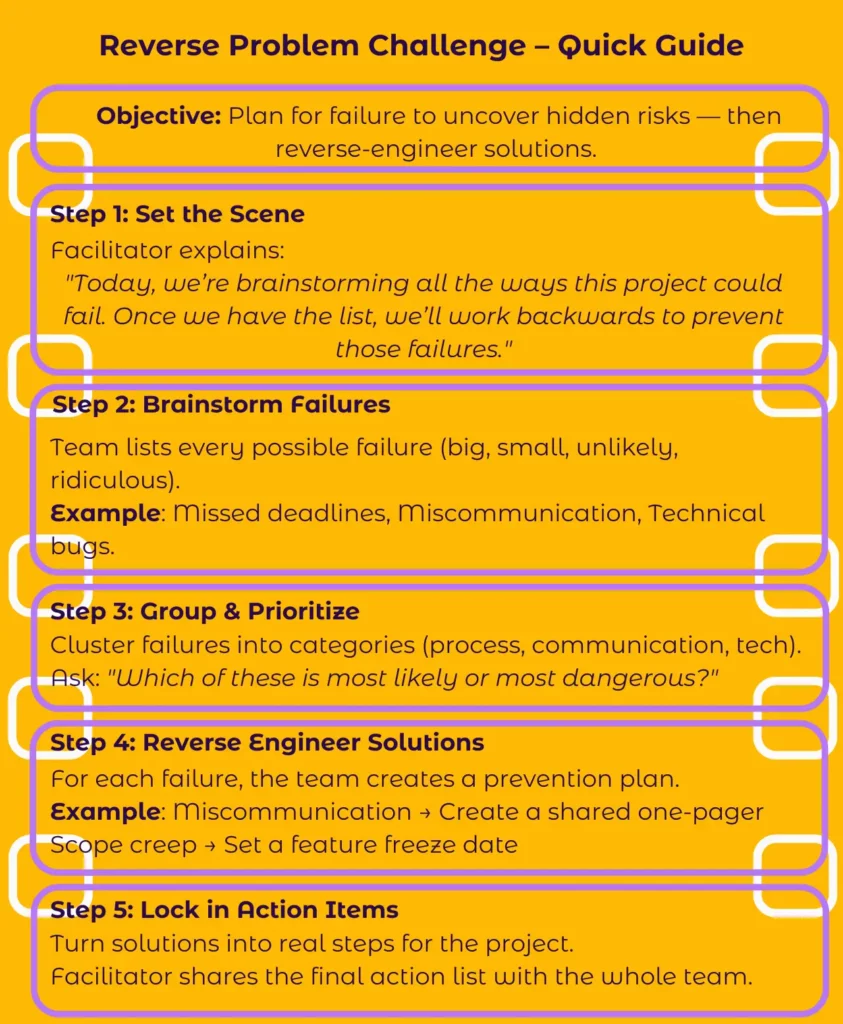
The Reverse Problem Challenge
Give the team a scenario, like launching a new product. Instead of solving it, they list every way the project could fail. Once the “failure map” is done, they work backwards and come up with a fix for each failure point. It pushes lateral thinking and brings up worries people usually keep to themselves.
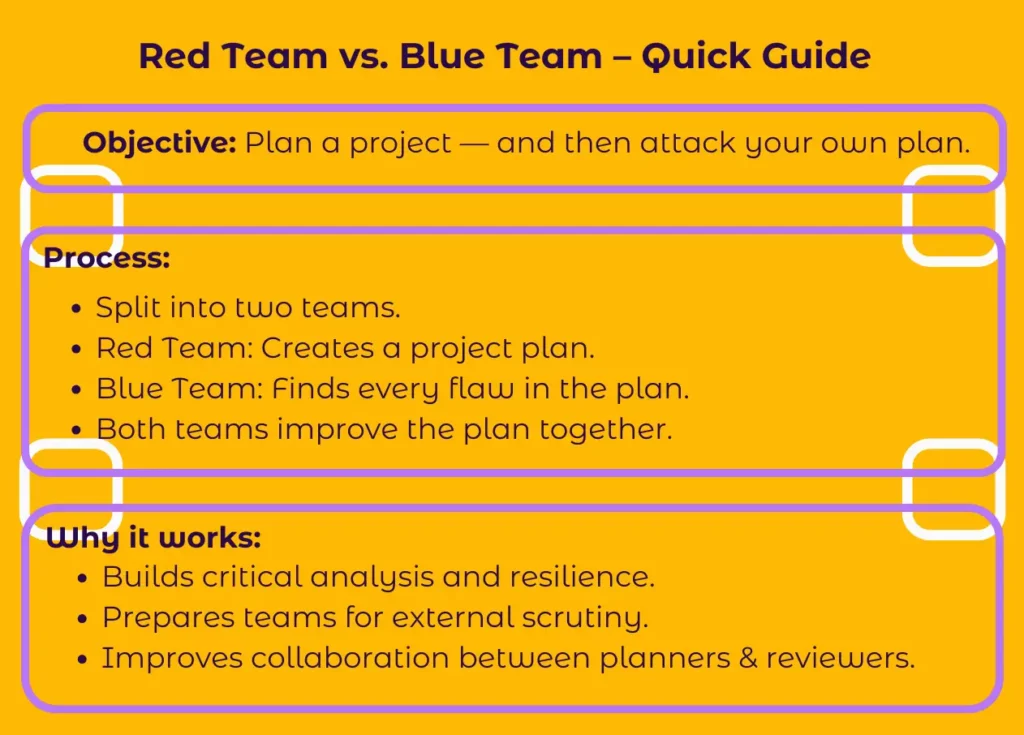
Red Team vs. Blue Team
Split the group in two. The Red Team writes a plan for a project. The Blue Team tries to poke holes in it and challenge every assumption. Then both sides come together to fix the plan. Good practice for taking criticism without getting defensive.
Crisis Scenario with Changing Information
Present a fake but realistic crisis, like a product recall or a social media mess. Every five minutes, add a new fact that changes the situation. The team has to update its plan on the fly. It’s a fun way to practise staying calm when things keep shifting.
Defend the Bad Idea
Hand the team an obviously flawed solution and ask them to defend it like it’s brilliant. Then they switch sides and tear their own arguments apart. It gets people laughing and trains them to see both sides of a problem.
The Assumptions Hunt
Before the team starts on a tricky scenario, they list every assumption they’re making about the problem, the people, the resources and the client. They can only move forward once they’ve checked each one. It helps teams solve the right problem instead of the first one they see.
Simple Problem-Solving Techniques to Pair With These Activities
Activities warm people up. These techniques help when the team faces a real problem at work:
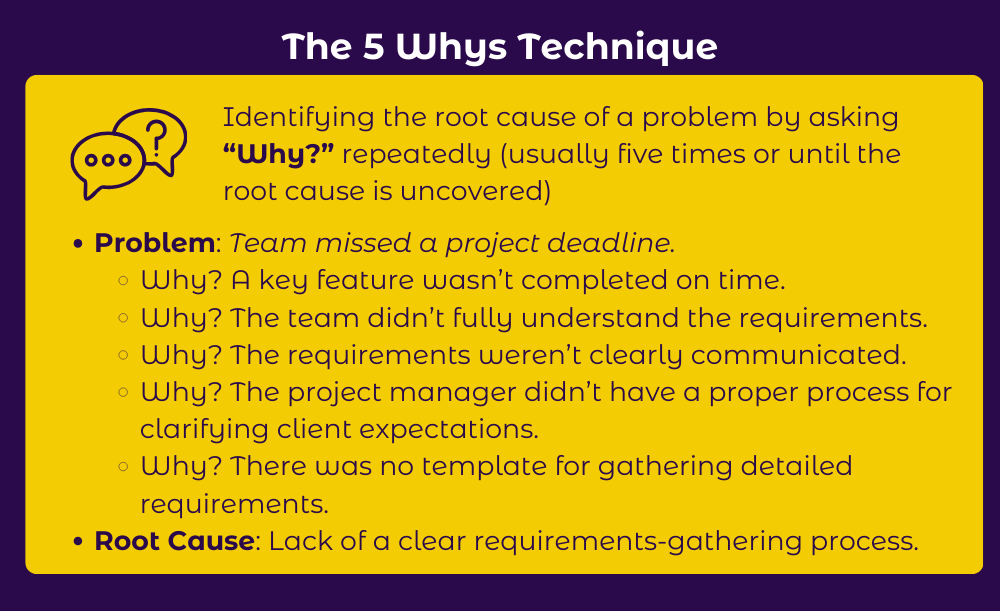
- 5 Whys: Ask “why?” five times in a row to get from the symptom to the root cause.
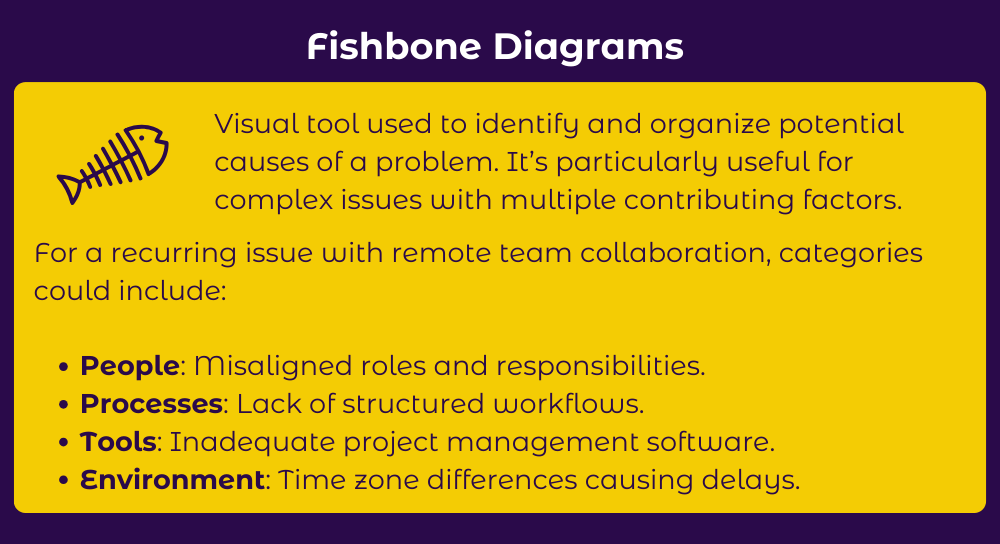
- Fishbone Diagram: Sort possible causes into groups (people, process, tools and so on) to see the whole picture.
- Retrospectives: After a project, talk through what went well, what didn’t and what to change next time.
- Step-by-Step Options Review: List the options, weigh them one by one, then pick one together.
Research on collective intelligence (Woolley et al., 2010) found that groups solve problems better when members take turns and contribute more evenly. That’s why the best exercises aren’t brain teasers for the smartest person in the room. They make every voice count.
How to Choose the Right Activity for Your Team
When selecting a problem-solving activity, consider the following:
- Team Size: Some activities work better for smaller groups, while others are ideal for larger teams.
- Location: Determine whether your team will participate remotely or in person.
- Objective: Identify what skills or outcomes you want to focus on (e.g., communication, creativity, teamwork).
- Engagement Level: Choose activities that match your team’s interests and energy levels.
The Role of Problem-Solving Activities in Remote Teams
Remote teams face unique challenges, such as communication barriers and feelings of isolation. Problem-solving activities can help overcome these obstacles by:
- Improving Virtual Collaboration: Games like Sync Squad and Keep Talking and Nobody Explodes require teamwork in a virtual setting, helping teams build rapport.
- Building Communication Skills: Remote activities emphasize the importance of clear, concise messaging.
- Boosting Engagement: Fun, interactive activities keep remote teams connected and motivated.
- Fixing Everyday Friction: Agree which tool is for what (for example, chat for quick updates and video calls for discussions), and use shared docs or diagrams when a problem gets complicated. Fewer mix-ups means more time spent on the actual problem.
Tips for Successful Team Building with Problem-Solving Activities
- Set Clear Goals: Define what you want to achieve through the activity.
- Encourage Participation: Ensure everyone feels included and valued.
- Chat Afterwards: Take a few minutes to talk about what worked, what didn’t, and what you’d try at work.
- Make It Fun: The more enjoyable the activity, the more engaged your team will be.
- Get Help With Big Groups: For larger sessions, a game master can host the game for you.
FAQs
What are the benefits of problem-solving activities for teams?
These activities improve communication, critical thinking, and collaboration while fostering trust and innovation within a team.
Can problem-solving activities work for remote teams?
Absolutely! Many activities, like virtual escape rooms or scavenger hunts, are designed specifically for remote teams and help overcome collaboration challenges. Learn more about online team games for remote teams.
How often should we schedule problem-solving team-building activities?
Regularly, such as quarterly or biannually, to maintain strong team dynamics and continuously improve skills.
What are some tools for virtual problem-solving activities?
Any video call works, plus a shared whiteboard for brainstorming. For games, browser-based co-op games like Sync Squad and Keep Talking and Nobody Explodes run from one link. Everyone plays on their own screen, with no download.
Conclusion
Team-building problem-solving activities are a powerful way to strengthen collaboration, boost morale, and develop critical skills within your team. Whether your team is in-person or remote, activities like virtual escape rooms, scavenger hunts, or the Marshmallow Spaghetti Tower can create meaningful connections while tackling challenges. Start integrating these activities into your team-building plans and watch your team’s problem-solving capabilities soar!