Critical Thinking Team Building Activities, a guide to smarter teams
When people think about team building, they often picture icebreakers or silly games. But in high performing teams, the real payoff comes from better thinking together. Critical thinking team building activities go beyond fun, they improve how teams frame problems, test assumptions, make decisions, and learn from mistakes, especially in remote and hybrid work.
If you’re also tackling feedback or virtual challenges in team settings, you may find these resources useful: Feedback and Coaching Challenges in Team Building, and Challenges in Running Virtual Team Events (and How to Overcome Them).
Quick answer
Critical thinking in teams means making reasoned judgments, based on evidence, context, and clear assumptions, then being willing to revise when new information appears.
The best critical thinking team building activities create ambiguity on purpose, then guide teams through structured discussion and a solid debrief.
What critical thinking looks like inside real teams:
- What critical thinking looks like inside real teams
- Teams that think well tend to do these things consistently
- They separate facts, assumptions, and opinions out loud.
- They ask better questions before proposing solutions.
- They make tradeoffs explicit, time, quality, risk, cost.
- They invite disagreement early, then commit clearly.
- They review decisions later, to learn how they thought, not only what happened.
What critical thinking looks like in real teams
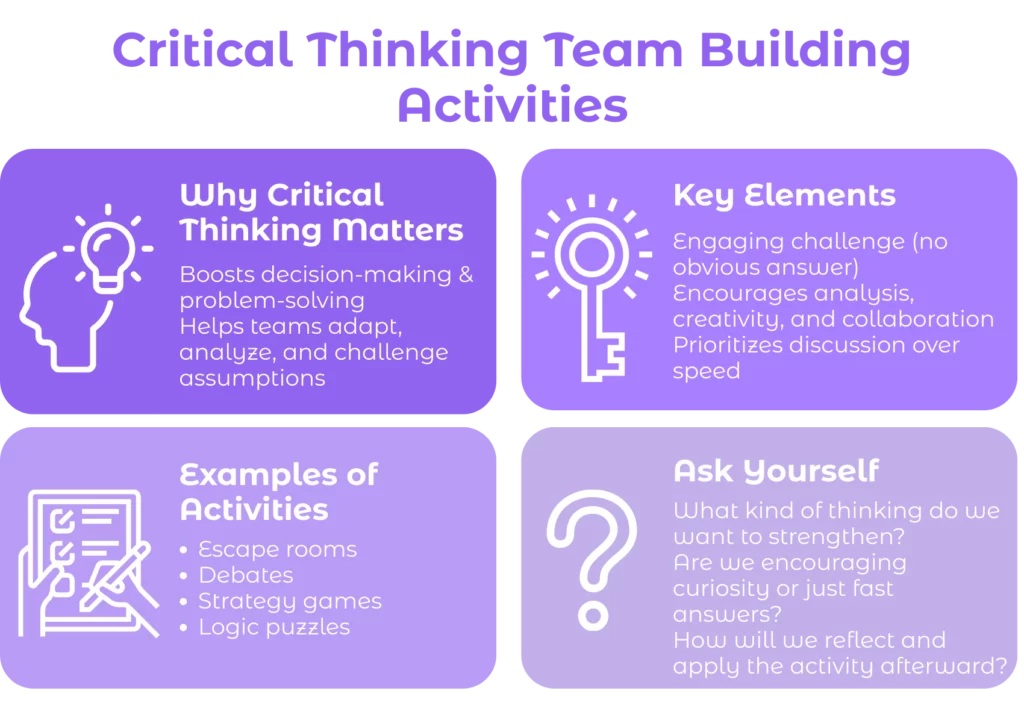
Critical thinking is purposeful, self regulating judgment. It includes interpretation, analysis, evaluation, inference, and explanation of why you reached a conclusion.
In a team setting, it shows up as behaviors, like these;
- Asking “what would change our mind” before committing
- Separating facts from guesses
- Surfacing hidden assumptions
- Inviting dissent early, not at the end
- Making tradeoffs explicit, time, quality, risk, cost
- Keeping a record of decisions, what we believed, why we chose it, what we will watch
Without it, teams:
- Default to groupthink
- Waste time on unstructured discussions
- Struggle to solve novel or complex problems
- Avoid conflict instead of learning from it
With it, teams:
- Think independently but work collaboratively
- Make smarter, faster decisions
- Stay agile in changing environments
- Learn from missteps and improve continuously
Critical thinking is not just about solving puzzles or answering trivia. It’s a habit of mind. Teams that regularly exercise this skill are more likely to:
- Spot risks early
- Test assumptions before acting on them
- Align better across departments
- Challenge each other constructively instead of personally
Whether you’re a team leader, L&D professional, or HR manager, building this muscle into your team culture can lead to better outcomes and healthier team dynamics.
A simple way to explain it to your team: Critical thinking is asking “what do we know, what are we guessing, what would change our mind” before we lock in a plan.
Key Elements of Effective Critical Thinking Team Building Activities
Not all team activities promote critical thinking. The best ones include:
- Open-ended challenges: No single right answer. Teams must weigh options, test ideas, and adapt.
- Time pressure: Forces prioritization, planning, and decision-making under stress.
- Limited information: Encourages investigation, questioning, and data-sharing.
- Cross-functional collaboration: Brings diverse knowledge and viewpoints into play.
- Post-activity reflection: Unlocks insights and creates behavioral learning loops.
Add these two elements if you want stronger results:
- Forced tradeoffs, teams must choose between competing goals (speed vs quality, scope vs certainty).
- Role rotation, someone leads, someone challenges, someone watches the process, then swap.
These activities have one thing in common: They simulate real work challenges, such as ambiguity, competing priorities, different stakeholder needs, and imperfect data. When teams regularly train in such environments, they become more resilient and better equipped to handle actual work stressors.
Examples include strategic escape rooms, simulation games, moral dilemmas, role reversals, and decision-making scenarios. But simple exercises, like structured debates or “devil’s advocate” role play, can promote cognitive flexibility.
Need inspiration for designing your own exercises? You can explore MindTools’ critical thinking toolkit.
Examples of Critical Thinking Team Building Activities That Work
- Virtual Escape Room (Logic-Focused) Teams must solve layered puzzles with limited hints. Success depends on collaboration, logical reasoning, and pattern recognition. Why it works: It encourages systematic thinking and the sharing of mental models under pressure.
- “If You Were the CEO” Simulation Teams are presented with a real-world company dilemma (e.g., product recall, PR crisis). They must analyze the situation, make a plan, and present their solution. Why it works: It mirrors complex decision-making with high stakes and limited time.
- Case Swap: One team presents a problem they’re facing at work. The other team must ask questions, challenge assumptions, and propose options. Then they swap roles. Why it works: It promotes empathy, perspective-taking, and structured problem framing.
- Build-a-Strategy: Given a fictional business or nonprofit, teams must build a plan with limited resources, shifting market data, and surprise challenges along the way. Why it works: This brings resource management, adaptability, and scenario planning into play.
- Moral Compass Challenge: Based on ethical dilemmas. Great for developing perspective-taking and decision-making under ambiguity. Why it works: Ethics-based activities create rich discussions and force people to consider non-obvious consequences.
You don’t need fancy tools to run these. What matters is the framing, the stakes (real or simulated), and the willingness to let teams wrestle with the unknown.
Looking for even more ideas? Read Problem Solving Exercises for Teams: 10 Real Activities that Build Smarter, Stronger Teams.
How to Facilitate Critical Thinking Team Building Activities
The success of these activities depends on setup and facilitation. Here are key tips:
- Set a clear goal: Are you working on decision-making? Communication? Bias awareness?
- Create psychological safety: Teams think better when they don’t fear being judged.
- Appoint a neutral facilitator: Someone who can challenge without dominating.
- Don’t rush the process: Critical thinking requires space to analyze and reflect.
Also consider:
- Varying the format: Not all teams engage the same way. Mix discussion, hands-on tasks, visuals, and writing.
- Using prompts or cards: These can help nudge quieter members into contributing.
- Letting teams fail: Sometimes the best thinking happens after things go wrong. Don’t sanitize the process.
How to Debrief Critical Thinking Team Building Activities
The debrief is where the real learning happens. Skip it, and the activity is just entertainment.
Structure your debrief around:
- What Happened?
- Recap the activity.
- Ask: What did you notice about how decisions were made?
- Why Did It Happen That Way?
- What influenced your choices? Bias? Assumptions? Lack of data?
- How did communication impact the outcome?
- What Would You Do Differently?
- Invite suggestions and “next time” strategies.
- What Will We Apply at Work?
- Connect the experience to real-world behavior.
- Set intentions or team agreements based on insights.
This step transforms the exercise into a feedback loop. Over time, repeated exposure and reflection can reshape team habits. Encourage every voice to be heard, and consider using a scoring tool or rubric to track team improvement over time.
Takeaway Prompts for Your Next Critical Thinking Team Building Session
- What specific thinking skills do we want to practice? (e.g., analysis, prioritization, ethical reasoning)
- Are we encouraging questions and debate, or just fast answers?
- Who is facilitating, and how will they stay neutral?
- How will we debrief and capture insights?
- How will this activity connect back to our real work?
Use these prompts to guide the design of your session and ensure it’s aligned with your team’s actual development goals.
Timeline to Integrate Critical Thinking Team Building Activities
Not sure where to start? Here’s a simple rollout plan:

Over time, this cadence builds psychological safety, shared language, and better mental models for collaboration.
Common Mistakes in Critical Thinking Team Building Activities
- Focusing too much on fun, not thinking
- Lack of reflection or poor debriefing
- Choosing activities that don’t align with team challenges
- Over-facilitating or under-facilitating
- Skipping psychological safety: If people don’t feel safe to speak up, true critical thinking won’t happen.
The Payoff of Critical Thinking Team Building Activities: Smarter, Stronger Teams
Critical thinking isn’t a buzzword. It’s a habit that can be cultivated through intentional practice. The right activities, paired with smart facilitation and meaningful reflection, can shift how your team works together. Over time, you’ll notice:
- Stronger problem-solving
- More constructive conflict
- Faster, clearer decisions
- Deeper trust and alignment
And perhaps most importantly, you’ll build a team that doesn’t panic when faced with a complex or ambiguous challenge. Instead, they lean in.
Don’t settle for surface-level bonding. Build a thinking team.
Need a Kickstart with Critical Thinking Team Building Activities?
If you’re looking for ready-to-run critical thinking games with built-in facilitation and reporting tools, check out browser-based team-building games that are designed for exactly this kind of deep thinking and interaction. Just make sure they come with a real debrief—that’s where the transformation happens.
And remember: you don’t need to overhaul your entire calendar. Start with one smart activity per quarter, debrief it well, and build from there. Small, thoughtful steps compound into big changes.