What’s the real value of team building in L&D programs?
Team building in L&D (Learning and Development) often sits in a gray zone. Some see it as essential for improving how teams learn and collaborate, while others dismiss it as time-wasting or unrelated to skill development. The truth is more complex.
When used with clear purpose, team building can improve retention, performance, and psychological safety. When misused or isolated from actual learning goals, it becomes forgettable and ineffective.
This article looks at the real impact of team building in L&D programs. It highlights what research says, where it works best, and how to avoid the common pitfalls that lead to wasted time and poor results.
What is the real role of team building in L&D?
L&D is not just about delivering knowledge. Its real goal is to help people change behavior, build new habits, and apply what they learn in practical settings. That is where team building in L&D becomes useful.
When designed well, team activities allow learners to:
- Practice new skills in context
- Interact with teammates in structured, goal-oriented ways
- Build trust and engagement that carries over into daily work
But this only works when the activities are tied to real learning objectives, placed in the right part of the learning journey, and followed by reflection.
What the research tells us about team building in learning programs
1. It improves performance, but context matters
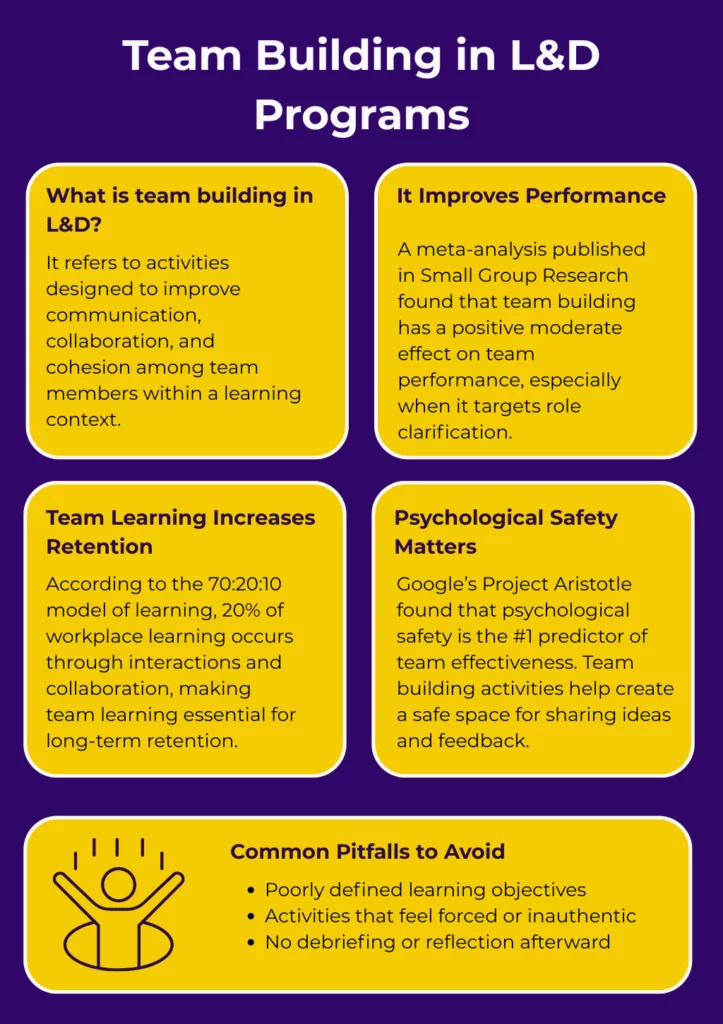
A widely cited meta-analysis in Small Group Research reviewed 103 studies and found that team building has a significant positive effect on performance and attitudes. However, not all formats work equally well.
The most effective types were those focused on:
- Goal setting
- Role clarification
- Problem-solving
Simple “get to know you” activities showed weaker results. This points to an important insight: team building works best when linked to shared purpose and real tasks.
2. Team learning boosts long-term retention
The 70-20-10 model suggests that most workplace learning (70 percent) comes from job experiences, 20 percent from interactions with others, and only 10 percent from formal training.
This model has critics, but its basic message still holds. Social learning accelerates the transfer of training to daily work. Team-based activities create shared memory, language, and alignment, which makes it easier to apply what was learned in training.
For example, a team that practices handling feedback during a structured activity will be more likely to give each other feedback after the training is over.
3. Psychological safety supports every other learning outcome
In Google’s Project Aristotle, psychological safety was identified as the top factor for high-performing teams. Without it, people hesitate to speak up, ask questions, or take initiative.
Team building does not create psychological safety on its own, but it can help. Activities that allow people to show vulnerability, ask for help, or reflect on group performance help set the tone for learning environments that feel safe and inclusive.
What about the criticism? FAQs with honest answers
Isn’t team building too soft or disconnected from learning?
Not when it’s done intentionally. The problem is not the concept, it’s the execution. If your L&D activity includes a blindfolded trust fall, but your learning goal is decision-making under uncertainty, the gap is too wide. But if your activity simulates a time-pressured task that requires delegation, coordination, and communication, then it becomes a tool for applied learning.
The key is to choose activities that reflect the skills you want to reinforce, and not to confuse fun with learning.
How often should we include team building in our L&D plans?
It depends on the goals, team maturity, and context. That said, it is more effective when included regularly in the learning process, not just once per year. For example, short interactive exercises can be included at the beginning or end of each module. Larger team simulations can be placed at key transitions, such as onboarding, upskilling, or leadership development.
How can we measure if it worked?
Good team building has ripple effects. You can look for signs like:
- More peer feedback after the activity
- Increased participation in training sessions
- Better collaboration between departments
- People using shared language from the session in later meetings
For more structured evaluation, apply the Kirkpatrick Model and look at learning, behavior change, and business results over time.
How to use team building across different stages of L&D
Onboarding: building clarity and connection
Team building is often skipped in onboarding programs, but it plays a critical role. New employees are figuring out how things work, who to go to for what, and how to fit in. A scenario-based team game can help them understand roles, develop working relationships, and reduce hesitation in reaching out across departments.
Try a simulation where new hires solve a challenge together, using mock versions of your communication tools and workflows.
Leadership development: stress-testing decision-making
For more experienced employees, bonding games won’t move the needle. Instead, use team-based simulations with ambiguous scenarios, conflicting priorities, or values-based dilemmas. These activities challenge leaders to make decisions, defend them, and adapt based on team input.
A well-designed game that introduces moral ambiguity or incomplete data can lead to excellent reflection on real leadership behaviors.
Ongoing learning: practicing behavior in context
Whether you are teaching agile methods, feedback techniques, or negotiation, team building activities give people a chance to try things out before they apply them in real situations. The activity acts as a bridge between theory and practice.
For example, teach a feedback model, then run a fast-paced task where teams need to give and receive rapid feedback to improve performance between rounds.
Final thoughts: team building is a learning tool, not just a social activity
Team building in L&D programs has real potential—but only when it’s used with care. It should support your training goals, reflect the challenges your teams face, and include space for reflection and feedback.
If you treat it as a side event, you’ll get side results. But if you embed it into the design of your learning experiences, it becomes a powerful driver of behavior change, alignment, and long-term learning.