5 Proven Ways to Measure Team Building Impact (Backed by Science)
Measure team building impact if you want to go beyond the good vibes and actually understand whether your efforts are improving collaboration, communication, and performance. While team building is often seen as a break from routine, its real value shows up in how teams work together afterward. So how do you know if it’s working?
In this post, we’ll break down five research-backed methods to measure the impact of team building activities, plus answer common questions companies have when trying to evaluate results. Each method goes beyond gut feeling and gives you tools to connect team building to measurable outcomes.
Why You Should Measure Team Building Impact
Team building is often misunderstood as just a “nice-to-have,” but science says otherwise.
A comprehensive meta-analysis published in Small Group Research reviewed over 100 studies and concluded that team building significantly improves performance, especially when focused on goal setting and interpersonal skills. The takeaway? Team building works — but only if it’s done with intention and followed by measurement.
Read the study here
Still, most companies don’t track results at all. Without measurement, it’s difficult to justify budget, improve future sessions, or identify what actually changed. Let’s look at how to measure impact meaningfully and efficiently.
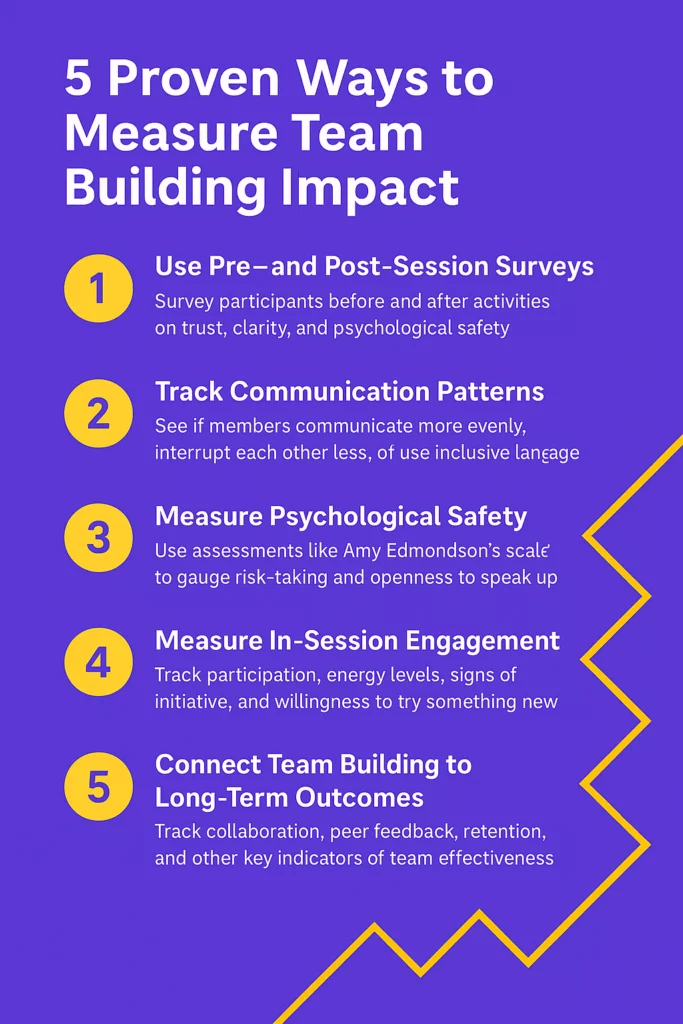
1. Use Pre- and Post-Session Surveys to Capture Real Change
Surveys are one of the most straightforward and scalable ways to measure change. The key is to run them before and after the session using questions tied to the outcomes you’re targeting.
For example, if your team building activity focuses on improving communication, your survey might include:
- I feel heard in team discussions.
- I know when to take the lead and when to step back.
- Our team resolves misunderstandings effectively.
Use a consistent scale, such as 1 to 5 (strongly disagree to strongly agree), and calculate the shift. Even a small increase in scores can show meaningful improvement.
This method is easy to set up with tools like Google Forms or Typeform, and if done consistently across multiple sessions, you’ll start building valuable internal benchmarks.
Tip: Make sure your survey doesn’t only ask about how fun the session was. Include statements tied to trust, clarity, and psychological safety to get a fuller picture.
2. Track Communication Patterns Before and After the Session
Communication is often one of the first team dynamics to shift after team building. But rather than just asking people how it went, look for actual behavioral changes.
In virtual sessions, some platforms can track:
- Who speaks and how often
- Whether interruptions decrease
- Use of inclusive language (we vs. I)
- The ratio of talking to listening
In live sessions, use a facilitator or observer to take notes. Watch for:
- Whether quieter team members participate more
- If dominant voices make space
- How quickly the team reaches consensus
These patterns often indicate improvements in how teams collaborate. For example, if more people start contributing equally, it could mean that psychological safety is increasing.
3. Measure Psychological Safety with a Trusted Framework
Psychological safety is a proven predictor of team performance. According to Google’s multi-year study Project Aristotle, it was the number one trait of high-performing teams.
To measure it, use Amy Edmondson’s 7-item scale (or a simplified version). Ask people to rate statements like:
- It’s safe to take a risk on this team.
- People on this team accept others being different.
- It’s easy to ask teammates for help.
Scores from before and after the team building session can help you see whether people feel safer to speak up or make mistakes — which leads to more honest conversations and innovation.
You can explore the framework in more detail here
This method is particularly valuable for teams working remotely, where psychological safety tends to erode more quickly due to reduced informal communication.
4. Measure In-Session Engagement and Participation
How people show up during the session often predicts how much they take away from it.
For example:
- Did the team stay engaged from start to finish?
- Who participated and who stayed silent?
- Did anyone show leadership, ask for feedback, or support others?
In hosted virtual games or simulations, facilitators can provide post-session data such as who collaborated the most or how decisions were made. If you’re running your own session, assign someone to observe and take notes on group behavior. Look for:
- Moments of shared laughter or tension release
- Willingness to try something new
- Increased eye contact (in person or on video)
- Active problem-solving under time pressure
You can even include a short post-event reflection form where participants note what felt challenging or meaningful. Engagement is a valuable early signal that people were mentally and emotionally involved — which boosts learning retention.
5. Connect Team Building to Longer-Term Outcomes
Some results take time to surface. That’s why it’s important to look beyond the session and connect your team building efforts to broader metrics.
You might track:
- Changes in peer-to-peer feedback scores over 3–6 months
- Increased collaboration across departments or time zones
- Drop in team conflicts or complaints
- Manager reports of more proactive behavior
For example, after quarterly team building sessions focused on empathy and clarity, one tech company noticed a 15% increase in employees reporting that they “know how their work connects to others’ goals.” That’s a direct link between team building and better alignment.
Even employee retention and promotion rates can reflect team cohesion, especially if you compare departments that have and haven’t engaged in regular sessions.
Tip: Keep a consistent measurement cadence. Check in with a short survey or performance review reflection every 2–3 months to track ongoing impact.
FAQs: Measuring Team Building Impact
How soon should I measure the impact of a session?
Run a short pre-survey a day or two before the event, and a post-survey within 24 hours after. For longer-term metrics, follow up 4 to 12 weeks later.
What if I don’t see a change?
No impact doesn’t always mean failure. It might mean your goals weren’t clear or that the session didn’t target the right behaviors. Use it as a signal to adjust your content, facilitation, or group size.
Isn’t team building meant to be fun? Why measure it?
Fun matters — but it’s not enough. When companies measure, they’re more likely to identify what works and repeat it. Otherwise, team building becomes just a feel-good event with no lasting value.
Do I need expensive tools to do this?
No. Most methods above can be done using free survey tools and simple observation. If you want deeper insights, tools like Superglue, Gong, or Microsoft Viva can help analyze communication and collaboration data at scale.
Final Thought: Don’t Guess — Measure
When you measure team building impact, you move from hoping your teams work better to knowing it. That’s a big difference when trying to get leadership buy-in, justify spending, or build a stronger culture.
Start with a simple survey. Watch how people interact. Connect what you observe to what you want to improve. Measurement is what turns activities into outcomes — and teams into high-performing teams.
Want help running better team building and tracking what actually changes?
Explore Superglue Games — team games with built-in performance and communication reporting to help your team learn through play.