High Performing Teams, What They Do Differently (and How to Build It)
High performing teams are not just teams with smart people, strong resumes, or good intentions. They are teams that work well together under real conditions. They know how to communicate clearly, handle pressure, stay accountable, and improve how they work before small issues turn into costly ones. Research from Google, Harvard, and Gallup all points in the same direction. Team performance is shaped less by individual star power and more by how the team interacts, how clearly work is structured, and whether people feel safe enough to speak up when it matters.
If you look at what managers and team leads ask in forums, the gap becomes even clearer. They are asking how to set expectations without killing ownership, how to hold people accountable without micromanaging, how to improve communication, and how to spot burnout before it starts dragging performance down. That is the real work of building high performance.
So what do high performing teams do differently?
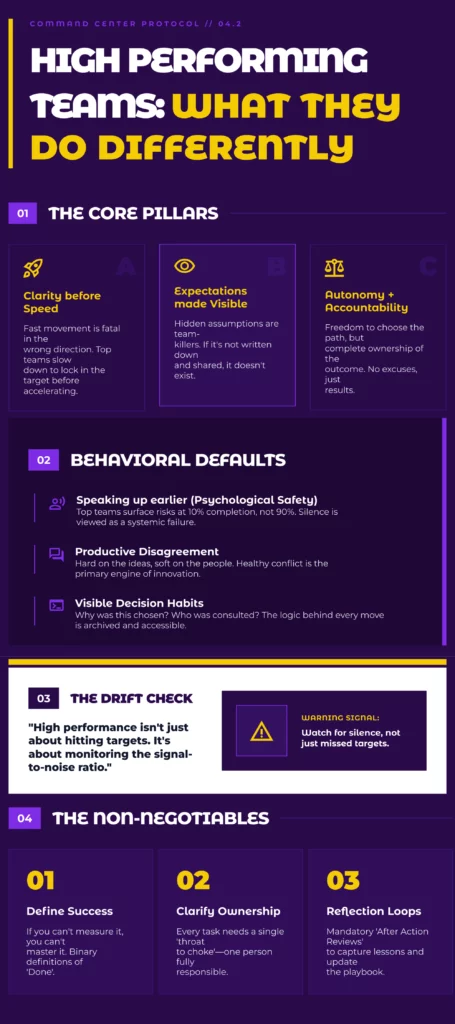
High performing teams create clarity before they chase speed
One of the biggest differences between average teams and high performing teams is that strong teams do not confuse motion with progress. They make roles, goals, ownership, and success criteria visible. Google’s research highlights structure and clarity as one of the key dynamics of effective teams, and Atlassian’s teamwork guidance makes the same point, clear roles reduce confusion, overlap, and conflict.
High performing teams make expectations visible
In weaker teams, expectations often live in someone’s head. People think they are aligned until something slips, a task gets duplicated, or a deadline is missed. In stronger teams, expectations are written down, repeated, and easy to reference. People know who owns what, what “done” means, and when to raise a flag. That is one reason forum discussions about team performance so often come back to ownership and decision-making.
High performing teams pair autonomy with accountability
A lot of teams struggle here. They either over-control work, which creates dependency and frustration, or they stay too hands-off and call the resulting mess “empowerment.” High performing teams do neither. They give people room to operate, but they also expect reliable follow-through. Google specifically highlights dependability as a core team dynamic, and in leadership discussions this tension often shows up as “how do I avoid micromanaging while still knowing what is going on?”
A simple rule helps here, track commitments and outcomes, not every tiny move. Teams perform better when updates are part of the workflow rather than a manager chasing status in Slack.
High performing teams speak up earlier
High performing teams do not wait for problems to become obvious. They raise concerns early, question assumptions, admit mistakes, and ask for help before work breaks down. That is where psychological safety matters, not as a nice extra, but as a practical operating condition. Google found it was the most important dynamic in effective teams, and Amy Edmondson’s work explains why, people need to be able to speak candidly without fear if the team wants to learn and adapt.
High performing teams build psychological safety into daily work
Psychological safety is often misunderstood as being endlessly nice. It is not that. It means people can challenge ideas, admit errors, ask questions, and share concerns without being punished or humiliated. Edmondson explicitly frames it around candor and speaking up, and current leadership discussions keep returning to the same point, safety is built in the small moments when someone disagrees, gets something wrong, or raises an uncomfortable point.
Trust is not the absence of accountability. It is what makes accountability easier to accept.
High performing teams disagree in ways that improve decisions
Conflict is not always a bad sign. In many cases, the real problem is fake agreement, delayed disagreement, or decisions made by the loudest voice in the room. Strong teams know how to challenge ideas without turning every disagreement into personal tension. They make it normal to test thinking, ask for counterarguments, and separate the idea from the person. Google’s guidance on psychological safety and current forum conversations about team communication both point toward the same behavior, teams get better when more voices can contribute without fear.
High performing teams make decision habits visible
One overlooked difference is that strong teams do not only review outcomes, they review how decisions were made. Did one person dominate? Was the owner clear? Did the group avoid the hard conversation until the last minute? Your own Superglue content on decision-making points to common breakdowns like endless discussion, unclear owners, and decisions driven by habit rather than clear criteria.
High performing teams protect focus and energy
A team can look busy and still be underperforming. High performing teams protect time, reduce avoidable friction, and notice the early signs of overload. In discussions about burnout, the warning signs are strikingly practical: people stop speaking up, feedback loops weaken, interruptions pile up, and nobody is clear on outcomes anymore. That is not just a wellbeing problem, it is a performance problem.
High performing teams reflect before small issues harden
Reflection is one of the least flashy but most valuable team habits. Strong teams do not wait for quarterly reviews or a full-blown crisis. They stop, look at how they worked, and adjust. Superglue’s own content on the performing stage makes this point well, momentum stays strong when teams protect focus, keep communication clean, and reflect before problems harden.
High performing teams watch for silence, not just missed targets
By the time output drops, the deeper issue has usually been building for a while. Silence in meetings, vague ownership, low-energy updates, quiet resentment, and reduced challenge are often the earlier signals. That pattern shows up clearly in leadership and Scrum discussions, where burnout is often described as people quietly disengaging long before the dashboard turns red.
That is why the best leaders pay attention to interaction patterns, not just delivery metrics.
How to build high performing teams in practice
The good news is that high performance is not some mysterious personality mix. It is built through repeatable habits.
High performing teams start with a few non-negotiables
Start here:
- Define what success looks like for the team, not just for individuals.
- Clarify ownership for every meaningful piece of work.
- Make updates part of the workflow so accountability does not feel like policing.
- Create room for dissent, questions, and early problem-raising.
- Review how decisions were made, not only whether they worked.
- Run short reflection loops so friction gets fixed quickly.
Every one of these habits is supported by the same mix of evidence: research emphasizes clarity, safety, and dependability, while forum discussions show what breaks when those conditions are missing.
High performing teams improve through practice, not theory alone
This is where a lot of team development falls short. Talking about trust is not the same as building it. Reading about communication is not the same as seeing what happens when a team is under time pressure, dealing with ambiguity, or trying to decide quickly with incomplete information.
That is one reason simulations, practice-based sessions, and guided debriefs are so useful. Superglue’s approach is built around observing how teams actually communicate, coordinate, make decisions, and respond to pressure in real time, then turning that into a short debrief and clear follow-up
Where Superglue and Leadership Training Ground can help
If your team needs a stronger communication rhythm, better coordination, or a safer way to surface weak spots, Superglue can help by putting the team into shared problem-solving scenarios that reveal how they actually work together. The platform is designed to improve communication, planning, decision-making, delegation, and group problem-solving, with reporting based on real in-game behavior rather than vague impressions.actions.
If your focus is leadership behavior more specifically, Leadership Training Ground is a strong fit because the idea behind it is not self-report, it is observing what leaders actually do in the moment, especially through communication. That makes it useful for teams that want to go beyond generic workshops and look at real patterns in how people lead, listen, direct, and respond under pressure.
High performing teams are built when people get to practice the hard parts of teamwork in realistic conditions, then reflect on what happened while the lesson is still fresh.
Keep in mind
High performing teams do not become high performing because they hired a few impressive individuals. They get there because they build better habits around clarity, accountability, communication, trust, and reflection. They make it easier to speak up, easier to own work, easier to spot friction, and easier to improve.
That is what they do differently.
And that is also how you build one.