Why Collaborative Learning Works (And When It Doesn’t)
Collaborative learning is often praised as a silver bullet for engagement, knowledge retention, and real-world skill building. But what actually makes it effective? When does it fall short? And how do you implement it in a way that actually helps people learn, not just socialize or divide up tasks?
This post explores the science behind collaborative learning, the conditions it needs to thrive, and what you can do to apply it meaningfully in your classroom, training, or team setting.
What is Collaborative Learning, Really?
Collaborative learning isn’t just about working in groups. It’s about constructing meaning together through active engagement, shared thinking, and open dialogue.
Instead of splitting up a project into isolated parts, group members work jointly toward solving a problem or making sense of a concept. The goal isn’t just completing the task but deepening understanding through interaction.
In a practical sense, collaborative learning might look like:
- A group of students brainstorming ideas for a history project while challenging each other’s assumptions
- A team of employees analyzing customer feedback to improve product design
- A peer-led study session where participants teach and quiz each other
The power lies in the social construction of knowledge. We don’t just “absorb” information, we shape it together.
Why Collaborative Learning Can Be So Effective
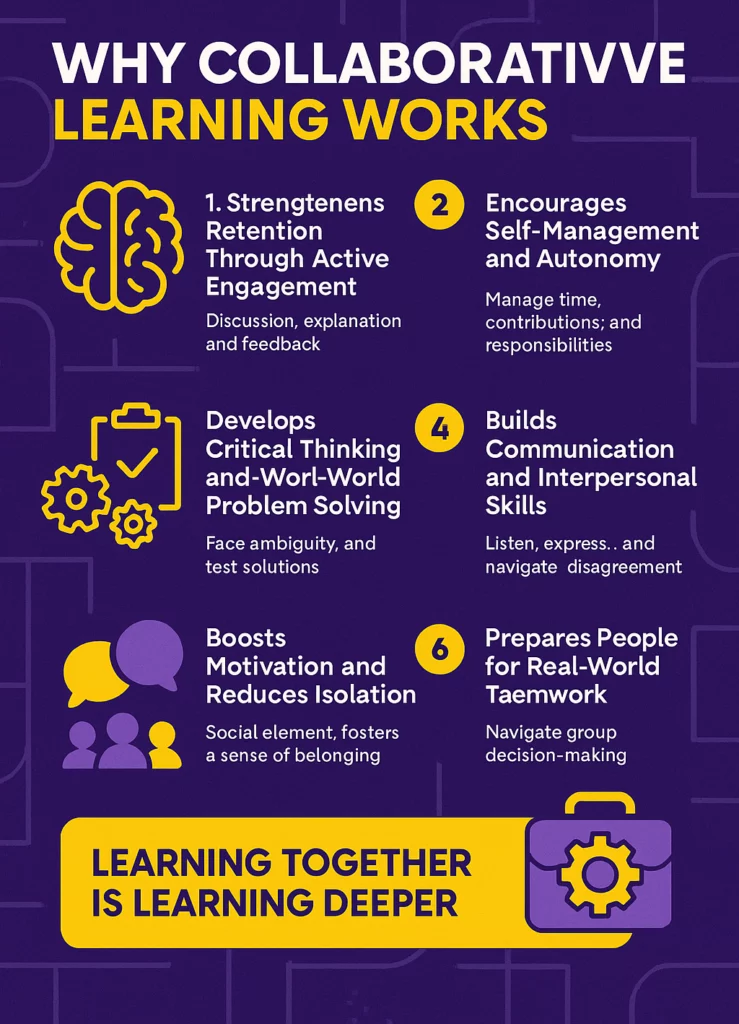
1. It Strengthens Retention Through Active Engagement
Passive learning methods like reading or listening only go so far. In contrast, collaborative learning encourages discussion, explanation, and feedback all of which help reinforce memory.
A study in Instructional Science found that students who discussed content with peers performed significantly better on recall tasks. The key factor? Cognitive elaboration explaining and questioning what’s being learned, which strengthens neural connections.
This is especially true when learners teach each other. The “protégé effect,” supported by multiple studies, shows that preparing to teach something can enhance understanding even more than being taught.
2. It Encourages Self-Management and Autonomy
In collaborative settings, learners must manage their time, contributions, and responsibilities. This builds autonomy in a way traditional instruction often doesn’t.
A 2018 study published in SAGE Open demonstrated that students in structured group settings developed stronger executive functioning skills such as task planning, emotional regulation, and decision-making.
But here’s the nuance: structure is key. Without defined roles and expectations, collaborative learning can easily devolve into uneven participation or confusion.
Giving learners agency is powerful, but that agency has to be supported, not assumed.
3. It Develops Critical Thinking and Real-World Problem Solving
When learners work together on open-ended problems, they face ambiguity. They have to ask questions, disagree, test solutions, and make tradeoffsjust like in the workplace.
The OECD’s global study on collaborative problem-solving found that students who frequently worked in groups outperformed others in solving unfamiliar tasks. They were better at managing complexity and integrating different perspectives.
This kind of practice is invaluable in fast-moving work environments, where most problems don’t come with clear instructions.
4. It Builds Communication and Interpersonal Skills
Collaborative learning is also a kind of soft skills training. To be effective, participants must:
- Listen actively
- Express themselves clearly
- Give and receive feedback
- Navigate disagreement respectfully
Over time, these experiences build confidence and empathy. This becomes especially important in diverse groups where misunderstandings are more likely and more valuable when resolved.
In a study published in the Journal of Educational Psychology, students involved in frequent collaborative learning reported long-term gains in both written and verbal communication.
5. It Boosts Motivation and Reduces Isolation
Learning can be lonely, especially in remote or independent settings. Collaboration brings in a social element that can boost motivation and create a sense of belonging.
When people feel that their input is valued and their peers rely on them, they tend to show more persistence especially when tasks get hard.
Collaborative learning doesn’t just teach content. It builds community.
This also helps with engagement in hybrid or online settings, where motivation can dip due to screen fatigue or lack of peer interaction.
6. It Prepares People for Real-World Teamwork
Whether you’re in school or in a job, success rarely comes from working in a vacuum. Most real-world outcomes depend on collaboration, often across departments, time zones, or cultures.
Collaborative learning mimics those dynamics. It gives learners practice in navigating group decision-making, integrating diverse perspectives, and managing collective goals.
Done well, it also helps people recognize group patterns: who tends to speak first, how disagreement is handled, and how decisions get made. These meta-skills are vital in complex, team-oriented work environments.
Want to explore how collaborative learning connects to broader team dynamics? Check out our guide on workplace collaboration, where we break down how teams can build shared habits, communicate more effectively, and become more connected and productive, especially in remote or hybrid environments.
Collaborative Learning Isn’t a Cure-All
Despite its strengths, collaborative learning doesn’t work equally well in every context.
Here’s where the nuance comes in:
- Group size matters. Larger groups often struggle with coordination. Research suggests 3 to 5 members as the sweet spot.
- Not all learners benefit equally. Without scaffolding, students with lower confidence or less background knowledge may withdraw.
- Misconceptions can spread. If no one in the group has accurate understanding, false beliefs can be reinforced.
- Social dynamics can distort learning. Peer pressure, conformity, or dominant voices can undermine open dialogue.
These aren’t arguments against collaborative learning. They’re reminders that design and facilitation matter.
How to Make Collaborative Learning Work
Here are some tested principles for setting it up effectively.
Choose the right kind of task
Avoid tasks with a single right answer. Opt for open-ended challenges that invite debate and multiple approaches. This invites deeper reasoning and perspective sharing.
Provide light structure
Assign roles, define the objective, and set time limits. Too much freedom can lead to chaos. Too much control kills engagement.
Scaffold participation
Use tools like sentence starters, checklists, or breakout discussion prompts. These support less confident learners and reduce cognitive load.
Check in on the process
After each session, debrief what worked and what didn’t. This encourages reflection not only on what was learned, but how the group worked together.
Consider asynchronous options
In remote settings, not everyone works best in real-time meetings. Allow collaboration through shared documents, message boards, or voice notes when possible.
FAQs: Getting Practical with Collaborative Learning
Is collaborative learning always better than solo learning?
Not always. For some tasks, like learning vocabulary or following a procedure, solo practice may be more efficient. Collaborative learning is most powerful for conceptual understanding, synthesis, and problem solving.
What tools work best for virtual collaborative learning?
Start with Google Docs, Miro, or Slack. If using Zoom or Teams, use breakout rooms and whiteboards. Keep tools minimal to avoid tool fatigue.
How do I prevent social loafing in groups?
Make individual contributions visible. Rotate roles. Use short peer evaluations to promote accountability.
Can collaborative learning work in assessment settings?
Yes, but it needs transparency. Use rubrics that reward both group output and individual insight. You can also combine group work with short personal reflections.
Final Thoughts: Learning Together is Learning Deeper
Collaborative learning works not because it’s trendy, but because it reflects how people think and grow in real life. When learners talk, struggle, and reason together, they go beyond memorization. They build the cognitive and social muscles that last well beyond a test or training session.
But it only works when designed with intention. It requires the right balance of autonomy and structure, challenge and support.
Done well, collaborative learning offers something rare: a way to grow not just as learners, but as contributors, teammates, and thinkers.
Want to go deeper?
Here are a few links worth reading: