How to Handle Conflicts in Remote Teams — And Can Team Building Actually Help?
Remote work solved one problem (commuting), but created another — invisible conflicts.
Without casual hallway chats, body language, or overheard conversations, many disagreements in remote teams either go unnoticed or quietly escalate until they blow up in Slack or a Zoom call. It’s not that remote teams fight more — it’s that they fight differently.
This blog breaks down the science behind remote team conflict, explains how to spot trouble before it erupts, and looks at whether team building activities can actually reduce conflict — or if they’re just a nice-to-have.
The Science of Conflict in Remote Teams — What Studies Actually Say
We know remote teams communicate differently — but how does that translate to more conflict?
One of the underlying factors in remote team conflict is low interpersonal trust — when people don’t know each other well, they’re quicker to assume bad intentions. If you want to proactively reduce this risk, start by actively building trust. We’ve outlined 8 science-backed strategies for doing exactly that in Building Trust in Virtual Teams: 8 Strategies for Success.
The Loss of Nonverbal Cues
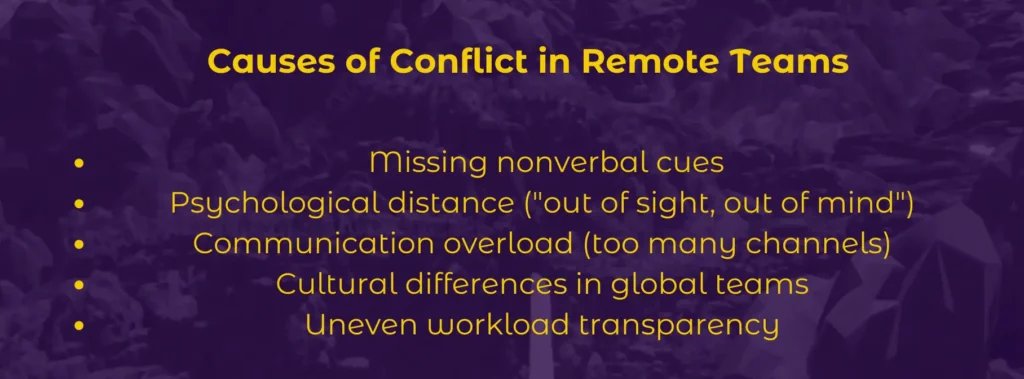
Up to 70% of human communication is nonverbal (Mehrabian, 1972). Remote work strips away most of that. Emojis and reaction gifs can’t fully replace tone of voice, facial expressions, or body language. Without those, people project their own assumptions into every message.
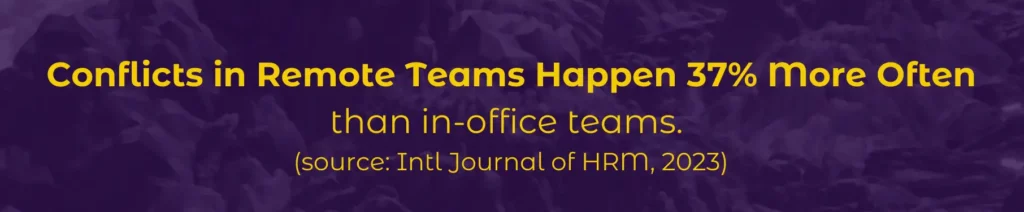
A 2023 study in the International Journal of Human Resource Management found that remote teams experience 37% more communication-related conflicts than in-office teams, simply because of these missing signals.
The “Out of Sight, Out of Mind” Effect
When you don’t physically see your coworkers, they become more abstract — almost like avatars, rather than real people. This psychological distance (Liberman & Trope, 2007) reduces empathy and increases the likelihood of misinterpretations.
Cognitive Overload from Too Many Digital Channels
Constant toggling between Slack, email, project boards, and video calls creates cognitive overload, reducing emotional self-regulation. When people are mentally drained, they snap faster and read negativity into neutral messages.
Signs a Remote Disagreement is Becoming a Real Conflict
You can’t read body language — but remote conflict leaves digital footprints. Watch for:
- Increasingly formal tone in messages (when colleagues normally chat casually)
- Long response delays from people who usually reply quickly
- Reduced participation in team calls
- Team members avoiding tagging or collaborating with each other in shared tools
The earlier you catch these, the easier they are to defuse.
Can Team Building Help Prevent and Resolve Conflicts in Remote Teams?
Spoiler: Yes — If You Do It Right
Team building often gets written off as “fluff”, but research says otherwise — when it focuses on communication, trust, and understanding working styles.
What Science Says
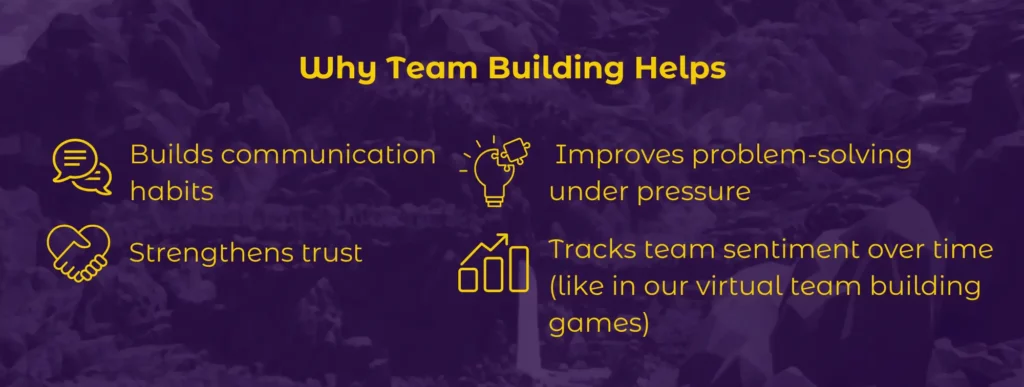
A meta-analysis in Organizational Psychology Review (Salas et al., 2020) found that teams with high-quality social interactions had 36% fewer destructive conflicts — meaning that teams who actively build relationships, trust, and communication patterns outside of day-to-day work are better equipped to handle disagreements productively.
Another study in the Journal of Applied Psychology (McEwan & Beauchamp, 2019) showed that collaborative problem-solving activities improved both communication quality and conflict resolution skills in teams. When teams work together to solve a challenge — especially one where success depends on clear communication and shared decision-making — they develop habits that directly transfer to real workplace situations.
Important: Virtual happy hours and casual online trivia sessions won’t magically solve workplace tensions. Team building works when it focuses on developing key team skills like communication, collaboration, and problem-solving — all while creating an environment where teams actually want to participate.
That’s exactly the approach we take with our virtual team building games. Each session lasts 60 to 90 minutes and is designed to improve:
- Communication clarity — Teams need to explain their thinking, ask questions, and make sure everyone is aligned.
- Collaboration under pressure — Every game requires teams to work together toward a shared goal, mirroring real-world project dynamics.
- Problem-solving as a group — Players need to pool their knowledge and think creatively to overcome in-game challenges.
- Engagement and fun — We make sure every session is genuinely enjoyable, keeping teams fully engaged from start to finish.
After each session, teams receive a Sentiment Report, which provides insight into:
- Overall team sentiment during the session — highlighting how positive or negative team communication was.
- Communication dynamics — showing how teams interacted, how balanced participation was, and whether collaboration improved over time.
- Trends across multiple sessions — helping teams see how their teamwork and communication evolve as they play together more often.
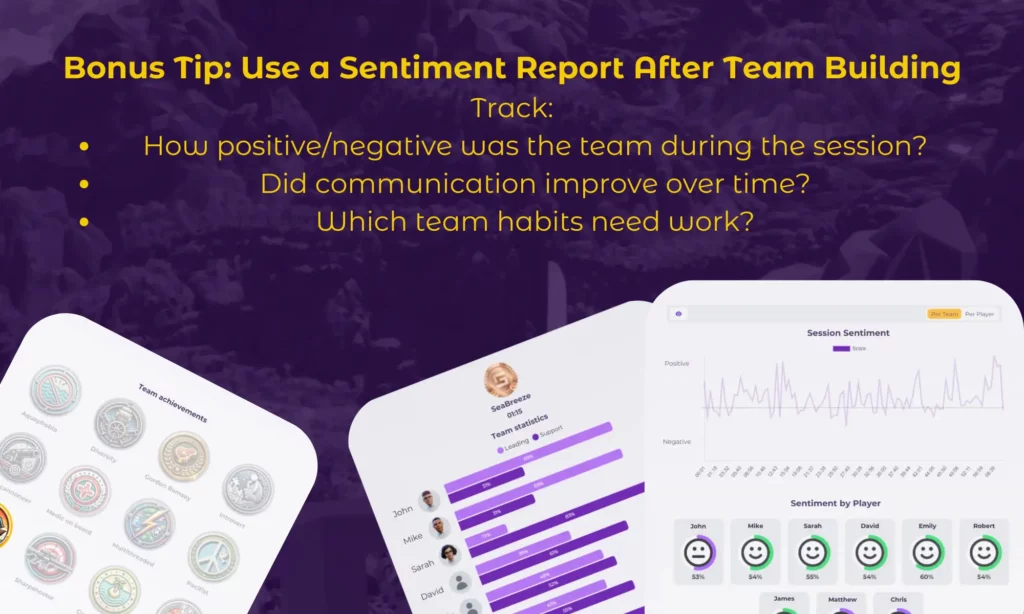
This combination of structured fun, skill development, and data-driven reflection creates a feedback loop that directly supports conflict prevention and stronger team cohesion — all while giving teams a much-needed break from regular work.
Which Team Building Activities Help Reduce Conflicts in Remote Teams?
Collaborative Puzzle or Escape Games
Why they work:
- Forces teams to practice clear, real-time communication.
- Exposes communication gaps in a low-stakes setting.
- Builds muscle memory for clarifying assumptions before acting — a core conflict resolution skill.
Example: Virtual escape rooms, collaborative story games, or interactive mysteries where teams solve clues together.
And if you want to take it a step further, consider adding nonverbal team-building activities into your rotation. Even in remote teams, these types of exercises can strengthen trust, sharpen intuition, and improve team cohesion. We covered some of the best nonverbal activities in Nonverbal Team-Building Activities for Stronger Collaboration and Trust.
“How We Work” Mapping
Why it works:
- Creates a manual for team interaction — covering everything from preferred communication style to response times.
- Normalizes cultural differences (which are a huge hidden source of conflict in global teams).
Example: Each team member creates a “User Guide to Me”, explaining how they prefer to give/receive feedback, handle disagreements, and structure their day. These are shared in a team workshop.
Structured Feedback Sessions (With a Facilitator)
Why it works:
- Creates a safe, regular space for surfacing frustrations before they harden into resentment.
- Models constructive disagreement so teams learn to disagree well.
Example: Monthly or quarterly Retro with Teeth — not just about processes, but interpersonal dynamics too. What’s working, what’s frustrating, and what could we do differently?
Conflict Simulations (Role Play)
Why it works:
- Builds conflict competence — so teams don’t panic when tension arises.
- Teaches teams to separate people from problems (a key principle from Harvard’s negotiation research).
Example: Practice resolving a fake remote conflict — like misaligned deadlines between teams. Teams follow a conflict script and debrief afterward.
If improving communication skills is a priority for your team (and it should be, especially if you’re seeing conflict patterns), we’ve compiled a list of team building activities specifically designed to strengthen communication in remote and hybrid teams. Check out Team Building Activities to Improve Communication Skills for actionable ideas you can use right away.
Quick Conflict Resolution Tips for Managers of Remote Teams
If tensions are already simmering, here’s your emergency playbook:
- Don’t mediate over Slack. Switch to video — facial expressions matter.
- Separate facts from feelings. What actually happened vs. what it felt like?
- Frame conflict as normal. Say “It’s okay to disagree — let’s figure it out together.”
- Align on shared goals. Conflict often happens when people think they’re solving different problems.
- Check assumptions. Did someone miss a message because they were offline? Misunderstanding != malice.
What About AI Tools for Conflict Detection?
This is emerging, but worth mentioning. Tools like Microsoft Viva or Worklytics can monitor:
- Tone shifts in team communication
- Drop-offs in response rates between specific people
- Negative sentiment creeping into written messages
They’re not a replacement for human judgment, but they can be early warning systems when paired with regular check-ins.
Conflict is a Signal, Not a Failure
In remote teams, conflict isn’t a bug — it’s a signal that something needs attention. Teams that learn to handle conflict early, openly, and skillfully become stronger, more innovative, and more resilient.
And yes — smart, intentional team building can help. Not by papering over problems with forced fun, but by giving teams the skills, trust, and habits they need to disagree productively.
References
Mehrabian, A. (1972). Nonverbal Communication. Transaction Publishers.
- Greer, L., & Dannals, J. (2021). Conflict in Teams: What We Know and What We Need to Know. Journal of Business and Psychology.
- Salas, E., Tannenbaum, S., & Kozlowski, S. (2020). Teamwork in Action: Lessons from the Field. Organizational Psychology Review.
- Liberman, N., & Trope, Y. (2007). The Construal Level Theory. Journal of Personality and Social Psychology.
- McEwan, D., & Beauchamp, M. (2019). Teamwork in Sport and Work: Meta-Analysis and Review. Journal of Applied Psychology.