Gamification in L&D: How to Make Learning Stick and Drive Real Results
Gamification in L&D is more than a shiny add-on. When done right, it’s a powerful tool for improving engagement, motivation, and knowledge retention. It turns passive learning into something active, sometimes even addictive.
The research backs this up. But more importantly, learners themselves are asking for training that feels less like a chore and more like something they want to do. In a digital-first workplace, where attention spans are short and expectations are high, gamification helps bridge the gap between what L&D teams offer and what employees actually use and remember.
Let’s look at how gamification works, the science behind it, and how to use it in a meaningful, evidence-based way.
What Is Gamification in L&D and Why Does It Matter?
Gamification in L&D refers to the application of game mechanics, like points, badges, levels, challenges, or progress tracking, within learning programs that are not games themselves. These mechanics are designed to increase learner engagement, drive behavior change, and improve performance outcomes.
But it’s not about “playing games at work.” It’s about integrating behavioral psychology into training environments. Games work because they provide clear goals, immediate feedback, a sense of autonomy, and progression. When learning programs do the same, learners engage more deeply and retain knowledge longer.
The Science: Why Gamification Works in L&D
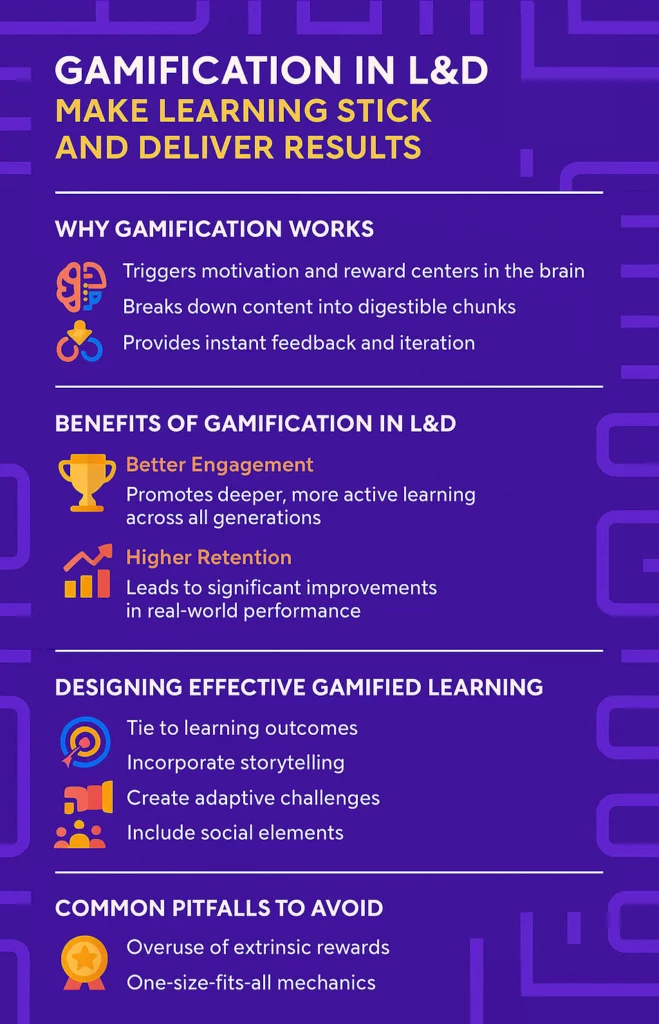
1. Motivation and Reward Systems
Gamification leverages our brain’s reward circuitry. When we complete a task and receive positive reinforcement, such as earning a badge or leveling up, it activates the dopaminergic system, which plays a central role in motivation and learning.
According to neuroscientist Dr. Judy Willis, “dopamine release promotes attention and memory, which are both necessary for learning.” Game-like feedback loops stimulate this process repeatedly.
2. Cognitive Load and Chunking
Game mechanics often break down learning into small, manageable units, which aligns with cognitive load theory. By reducing the mental effort needed to process new information, gamification makes learning feel more doable, especially for complex or compliance-heavy topics.
3. Feedback and Iteration
Instant feedback, a hallmark of well-designed games, is crucial for learning. A study from the Journal of Educational Psychology found that learners who received immediate corrective feedback significantly outperformed those who got delayed or no feedback. Gamification allows for real-time responses and correction without fear of embarrassment.
4. Flow State and Deep Engagement
Gamified learning systems often strike a balance between challenge and skill, creating conditions for a “flow state.” This state of deep immersion is linked with improved retention and intrinsic motivation. It’s one reason simulation-based learning is so effective for leadership development or crisis training.
Benefits of Gamification in L&D: More Than Just Fun
Better Engagement Across Generations
Gamification appeals to digital-native employees, but research shows it also benefits older learners. A 2021 study in Educational Technology & Society found that learners aged 45+ reported increased satisfaction and perceived effectiveness when gamification was used in e-learning modules.
Higher Retention and Performance
- IBM reported a 400% improvement in sales performance after incorporating gamified elements into their training program.
- Deloitte used a gamified onboarding program and saw completion times drop from 3 months to 2 weeks.
These aren’t isolated cases. When gamification supports real skill development, not just superficial progress, it leads to real business outcomes.
How to Design Gamified Learning That Actually Works
1. Align Game Mechanics With Learning Goals
Avoid “pointsification.” Points and badges alone won’t improve learning unless they reinforce relevant behaviors. If you’re teaching negotiation skills, for example, rewarding collaboration and active listening matters more than speed or clicks.
2. Create a Narrative Structure
Storytelling improves emotional connection and memory encoding. Consider structuring your program around a mission or quest. Learners can become characters in a story where each challenge unlocks new capabilities. This is particularly effective in leadership or DEI training, where empathy and context are key.
3. Add Adaptive Difficulty
Like good games, learning experiences should adapt to the learner’s performance. Too easy, and learners disengage. Too hard, and they give up. Adaptive gamification uses branching scenarios or AI to tailor content difficulty, keeping learners in the zone of proximal development.
4. Include Social Dynamics—But Carefully
Leaderboards can motivate high performers but alienate others. Consider instead:
- Team-based challenges
- Progress sharing within peer groups
- Collaborative missions
These promote social learning, which is proven to increase knowledge transfer and retention.
Common Pitfalls in Gamification (And How to Avoid Them)
| Pitfall | Fix |
|---|---|
| Overuse of extrinsic rewards | Tie rewards to intrinsic motivators like mastery, autonomy, and purpose |
| One-size-fits-all mechanics | Customize elements based on learner profiles or roles |
| Lack of meaningful feedback | Use micro-feedback to reinforce effort, not just outcomes |
| Short-term engagement only | Build long-term systems with progression paths and reflection |
Tools That Make Gamification in L&D Easier
Some platforms make it easier to integrate gamification into your existing learning stack:
- Axonify – Gamified microlearning tailored to frontline teams
- Superglue Games – Virtual team building with strucutred debriefs
- TalentLMS – Customizable LMS with gamification built-in
- Classcraft – Especially useful for soft skills training and narrative-based learning
- Quizizz / Kahoot – Great for interactive quizzes and low-barrier gamified reviews
Many of these integrate with existing systems, so you can try out gamified modules without overhauling your entire LMS.
See this G2 list of top gamification tools for more.
Frequently Asked Questions
Is gamification effective for serious topics like compliance or finance?
Yes, when it’s thoughtfully designed. Gamification doesn’t trivialize content,it makes it more digestible. For example, cybersecurity training often uses simulations to test responses to phishing attacks in real-time, which is more effective than passive video lectures.
What’s the ROI of gamification in corporate training?
It varies, but research from TalentLMS shows that 83% of employees who undergo gamified training feel more motivated, and 61% of those receive better feedback on their performance. The ROI becomes clearer when training goals are tied to performance metrics.
How do you handle learners who dislike games?
Not everyone wants flashy graphics or leaderboards. Good gamification is flexible and can be integrated subtly, like adding adaptive quizzes, feedback loops, or branching scenarios. You can offer opt-outs for more traditional learners while keeping the core learning goals intact.
Final Thoughts: Design for Behavior, Not Just Attention
Gamification in L&D isn’t about gimmicks. It’s about creating learning experiences that mirror how people already engage with content outside work, interactive, rewarding, and tailored to them.
Start small. Build one module that gives instant feedback and tracks progress. Test it. Talk to learners. Iterate. Then scale.
Done right, gamification in L&D turns learning into a habit. Not because it’s required, but because it’s something people want to come back to.