Effective Communication Strategies for Trainers
Practical tips backed by research that actually help people learn
Strong communication strategies are at the core of every successful training session. As a trainer, how you deliver information matters just as much as what you’re teaching. When communication is clear, engaging, and relevant, learners are more likely to understand, apply, and retain what they’ve learned.
This blog walks through the most effective communication strategies for trainers, combining insights from learning science with practical methods you can apply right away. Whether you’re working with new hires, seasoned professionals, or mixed groups, these techniques will help you connect, adapt, and create a better learning experience.
1. Start with the learner
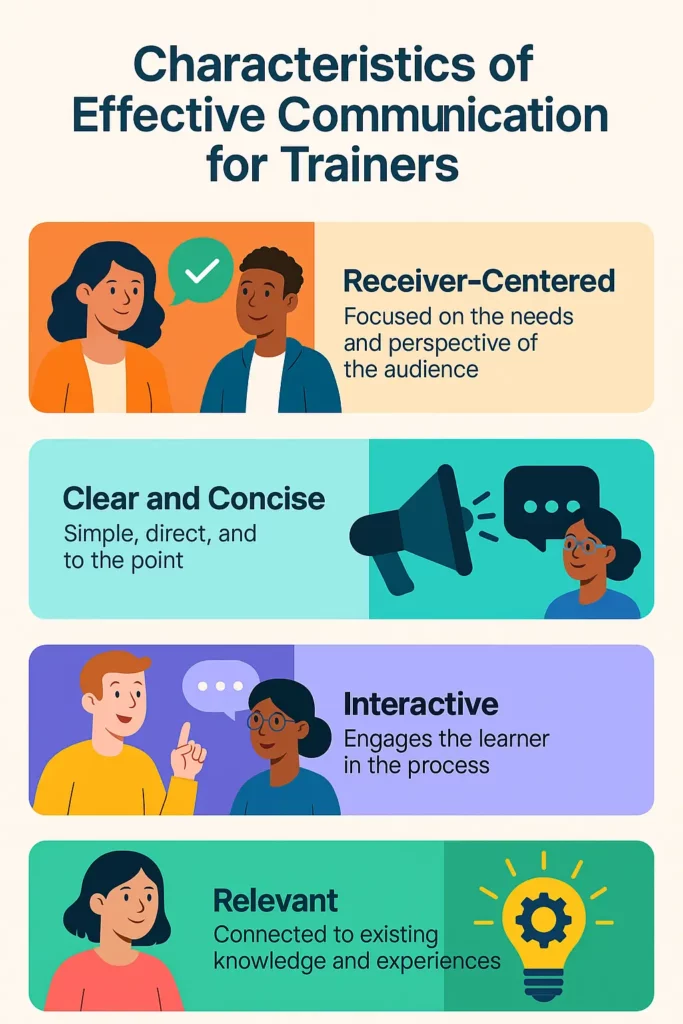
Use audience-focused communication strategies from the start
Before you even plan your session, spend time understanding your audience. What’s their current knowledge level? What’s relevant to them? What problems are they trying to solve?
You don’t need to overcomplicate it. Ask yourself:
- Who are they and what do they care about?
- What outcome matters most to them?
- Are there different experience levels in the group?
This simple thinking helps you shape examples, tone, pace, and even the format of the training. For example, new hires might benefit from more structure and visuals, while experienced employees may prefer scenario-based problem solving.
Tip: For mixed-skill groups, design layered content: core concepts for everyone, optional deeper layers for advanced learners.
2. Make your message clear and focused
Communication strategies for keeping your message simple and memorable
Trainers often try to pack in too much. Instead, decide early what the key takeaway should be. What do you want learners to remember a week later?
Use this core message to structure your session. You can support it with stories, examples, or data, but always tie it back to your central point.
A clear structure helps learners follow along and know what to expect. A common format is:
- Introduce the topic and why it matters
- Break it down into logical parts
- End with a recap and reflection
Question we often get:
“How do I make sure my message sticks?”
Use repetition with variation. Say it, show it, ask them to say it back, and apply it in an activity. The brain learns through repeated exposure and connections to context.
3. Use plain language and visuals
Communication strategies that improve understanding and recall
Avoiding jargon is essential to overcoming the curse of knowledge, where experts assume others understand what they know source.
Visuals help a lot — diagrams, charts, flow models, short videos. People remember more when they can picture it.
For abstract concepts, try using metaphors or comparisons. For example, when explaining how APIs work, you might compare them to restaurant menus: you don’t need to know how the kitchen works, just how to order what you want.
Real-life tip: If you can explain it to someone outside your field, you’re probably on the right track.
4. Make it interactive, not just informative
Why active learning is a powerful communication strategy
Research shows that active learning techniques significantly improve learner performance compared to passive methods source.
This doesn’t need to be high-tech. Try these:
- Ask open-ended questions during the session
- Use think-pair-share to get learners talking
- Include short role-play or case study exercises
- Try a quiz or poll to check understanding
- Pause and ask “How would you use this at work?”
Common question:
“What works for large groups?”
In big sessions, use breakout rooms, short polls, or collaborative docs. Even short pauses to reflect or type in the chat make a difference.
5. Listen, adapt, and respond
Real-time communication strategies for better learner engagement
Training should be flexible. If you notice confused looks or silence, pause and check in. Ask, “Does this make sense so far?” or “Would it help to go over that again?”
Active listening is also part of communication. Give learners room to ask, reflect, or push back. Sometimes what they don’t say is just as important.
You can also use check-ins or anonymous questions if the group seems hesitant. Encourage honest feedback throughout, not just at the end.
Tip: Create a culture where questions are normal. It increases engagement and reduces stress.
6. Build connections between new and old knowledge
Communication strategies that link concepts to real-world context
One of the best ways to help people learn is to connect new concepts to what they already know. This is called associative learning, and it’s supported by decades of cognitive research.
When you introduce a new idea, ask:
- “What does this remind you of?”
- “Have you seen this before in your work?”
- “What’s different about this compared to how you currently do it?”
People retain new information better when it’s linked to familiar experiences. Use workplace scenarios, relevant tools, or real examples from their daily challenges.
7. Space learning over time
Communication strategies that support long-term retention
We all forget quickly if we only hear something once. Spaced repetition — the idea of revisiting concepts several times over a period — boosts memory and learning.
You can build this into your training by:
- Reviewing key points after breaks
- Sending a short follow-up email or quiz
- Using a “last week recap” at the start of each new session
Microlearning (short, focused learning sessions) also helps. For example, a 10-minute practice exercise delivered two days after training helps reinforce the content.
Frequently asked question:
“How do I make training stick without taking more time?”
Use small follow-ups. Even a 2-minute reminder video or one-sentence email summary helps activate memory and keeps concepts alive.
8. Use the right tools — but keep it simple
Digital communication strategies that enhance, not overwhelm
You don’t need fancy tech to communicate well. But tools like video calls, whiteboards, breakout rooms, or shared docs can help when used with purpose.
In virtual training, visuals and interactivity are even more important. Don’t just present slides — ask questions, use breakout groups, and show your face on camera to create connection.
If you’re experimenting with VR, AR or gamified training, make sure they add clarity, not just novelty.
Final thoughts
Training is never just about content — it’s about how the message is shared, understood, and used.
The best trainers aren’t those who know the most, but those who can explain clearly, adapt to the group, and create a space where learning feels doable and meaningful.
Summary checklist for trainers
- Understand your learners before you design
- Choose one clear takeaway per session
- Speak simply, use visuals
- Invite interaction early and often
- Build on what learners already know
- Listen actively and adapt in real time
- Space out review and practice
- Keep tools purposeful and easy to use