Bridging the Skills Gap: Training for Tomorrow
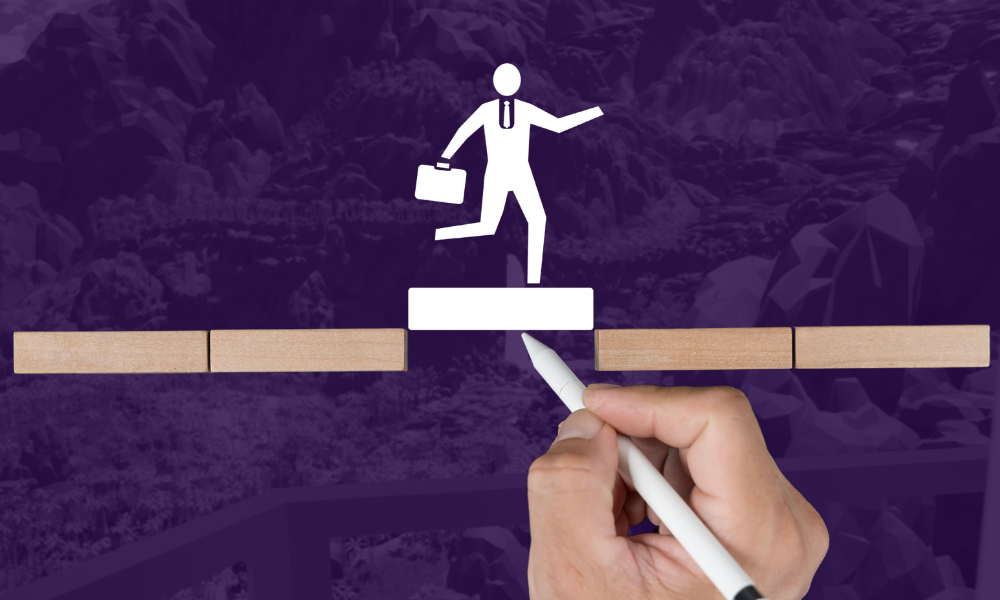
Skills gap is the phrase most companies use, but what they are really experiencing is a mismatch between what work requires this quarter and what people have had enough practice doing in real conditions.
In remote and hybrid teams, that mismatch shows up faster, because the “easy” learning (overhearing how someone handles a tricky customer call, shadowing a senior teammate, quick desk-side feedback) disappears. And when work changes quickly, the gap widens even if your team is smart and motivated. The World Economic Forum flags skill gaps as the biggest barrier to business transformation, and notes that a large share of workers will need training by 2030.
This guide breaks down the challenges behind the skill gap in remote and hybrid settings, plus a practical training system you can actually run without turning everyone’s calendar into a learning graveyard.
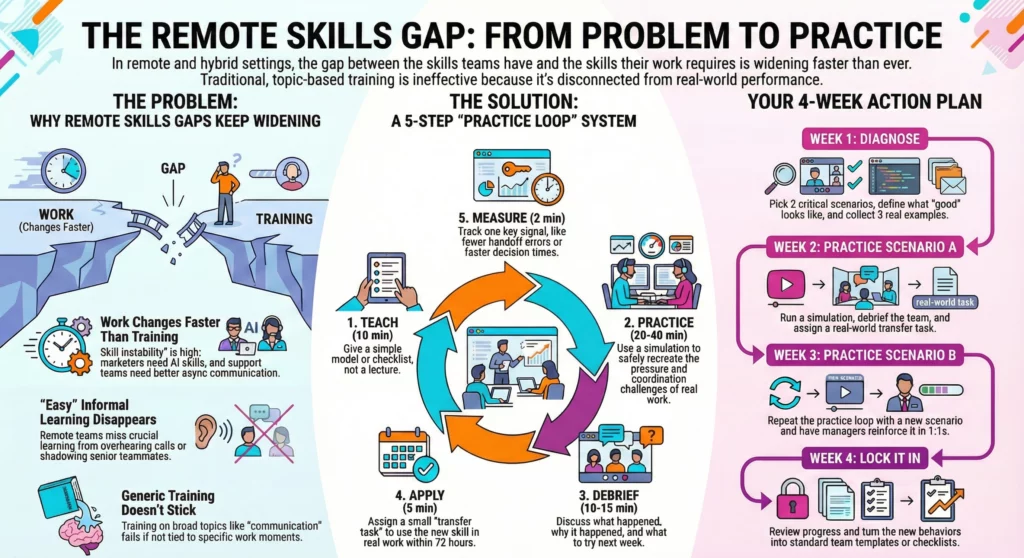
Why the skills gap keeps widening in remote and hybrid work
1) Work is changing faster than job descriptions
The WEF’s Future of Jobs Report 2025 digest highlights “skill instability” and a big shift in skills needs through 2025–2030.
What this looks like day to day
- A marketer who now needs basic AI workflow skills and stronger cross-functional alignment
- A support team that suddenly needs better judgment, escalation writing, and calm decision-making in async channels
- A product team that needs tighter experimentation discipline and clearer communication, because “quick syncs” stopped working across time zones
2) Training often targets “topics,” not performance
“Communication training” is vague. People do not fail at communication in general, they fail in specific moments:
- The handoff that lacks context
- The Slack message that triggers defensiveness
- The decision that gets delayed because ownership is unclear
If training is not anchored in those moments, it becomes content consumption, not capability building.
3) Leaders feel the pressure, but time is the constraint
LinkedIn’s 2025 Workplace Learning Report points to a skills crisis feeling among learning and talent development professionals.
Remote and hybrid environments amplify a simple reality: if training competes with delivery, training loses.
The skills gap diagnosis: find the scenarios that matter
Most teams start with a skills list. Flip it.
Start with critical scenarios, then derive the skills needed.
Step 1: List 8–12 “make or break” scenarios
Examples for remote and hybrid teams:
- A project is slipping and the team has to reset scope fast
- A customer escalation is brewing and tone matters
- A decision is blocked because stakeholders disagree
- Two teams hand off work across time zones and context gets lost
Step 2: Define “good” in observable terms
For each scenario, write:
- What good output looks like (example: “decision logged, owner named, next step scheduled, risks stated”)
- What bad output looks like (example: “vague agreement, no owner, follow-up in 2 weeks”)
Step 3: Collect light-weight evidence
No surveillance needed, just signals:
- Short self-checks before and after a sprint
- Manager observation notes
- Samples of real work (handoff docs, incident write-ups, decision logs)
Helpful external lens: The OECD has been emphasizing skills mismatches and skills-first approaches in workforce development discussions.
Closing the skill gap: the “Practice Loop” training system
A practical rule: skills change when people practice under constraints, then reflect, then try again.
Use this loop:
1) Teach only what you will practice (10 minutes)
Give a simple model or checklist, not a lecture.
Example: a 4-line async decision note format:
- Decision needed
- Options considered
- Recommendation and why
- Owner and deadline
2) Practice in a simulation (20–40 minutes)
Simulations are the bridge between theory and real work. They are especially effective for remote and hybrid teams because they recreate pressure and coordination problems safely.
Read: Training for soft skills, scenarios vs games and how to design them
3) Debrief with structure (10–15 minutes)
A debrief turns “that was fun” into behavior change:
- What happened
- Why it happened
- What to try next week
Read: Mastering the team building debrief
4) Apply in real work within 72 hours (5 minutes)
Assign a tiny “transfer task”:
- “Use the decision note format in the next stakeholder thread”
- “Write one handoff doc with the new template”
5) Measure one signal, not everything (2 minutes)
Pick one leading indicator per scenario:
- Fewer back-and-forth clarification messages
- Faster time to decision
- Fewer handoff defects
- Higher confidence ratings after retros
Skill gap challenges in remote and hybrid teams, and what to do about them
Challenge: “We cannot see the gaps”
In-office, managers notice who struggles. Remote, struggles hide until something breaks.
Solution
- Add a monthly “scenario review” where teams bring one real artifact (handoff, escalation, decision log) and diagnose it together.
- Use short simulations to surface patterns safely.
Challenge: Training is too generic to stick
People tune out when examples do not match their reality.
Solution
- Custom scenarios from your own workflows.
- Rotate scenarios by function (CS, Product, Ops) but keep shared teamwork skills consistent.
Challenge: Leaders want training, but managers do not have time to coach
This is where most programs die.
Solution
- Give managers a micro-kit: 3 prompts to use in 1:1s, plus one observable behavior to watch for.
- Keep it “small but frequent,” not “big but rare.”
McKinsey has also emphasized that upskilling is no longer just for “tech teams,” it needs to be broad and practical.
Using games and simulations to bridge the skill gap (without making it cringe)
If your team hears “training” and expects slides, energy drops. The workaround is simulation-based learning that feels like problem-solving, because it is.
Superglue sessions are built around teamwork behaviors (communication under pressure, planning, decision-making), and they end with guided reflection and a report you can use to set next steps.
Here are additional resources, that can help you:
- Decision making games for teams, ideas and a 60-minute agenda
- Problem solving exercises for teams
- How to handle conflicts in remote teams
A simple 4-week plan to reduce a skill gap in a remote team
Week 1: Diagnose
- Pick 2 scenarios that cause the most pain
- Define what “good” looks like
- Collect 3 real artifacts (examples from work)
Week 2: Practice
- Run one simulation focused on Scenario A
- Debrief, pick 1 behavior change
- Assign a transfer task for the next 72 hours
Week 3: Repeat with Scenario B
- New simulation, same loop
- Managers use 3 debrief prompts in 1:1s
Week 4: Lock it in
- Review before/after artifacts
- Decide what becomes standard (templates, norms, checklists)
- Set one monthly simulation to keep the muscle active
If you want a ready-made simulation format that works well for remote and hybrid groups, start here:
- Internal: Explore the game library Superglue.games
- Internal: Plan My Event
The skill gap is not closed by “more learning,” it is closed by more practice in the moments that matter, followed by reflection and real-world application. The teams that win treat training as an operating system, not an occasional event.
If you tell me your team type (example: product, support, sales, engineering) and the top 2 scenarios that keep going wrong, I can turn this into a tailored 4-week program with exact prompts, templates, and a session agenda.