Communication skills for managers

Whether you were promoted from within or hired to lead a new team, your biggest multiplier is communication. New managers often focus on tasks and tools, while the real leverage sits in how you listen, frame decisions, give feedback, delegate, and write clearly for async work. Below is a practical guide you can apply this week, complete with drills and a structured debrief.
What makes communication hard in your first 90 days?
- You are switching from solving problems to coordinating people.
- Your old peers now look to you for clarity, priorities, and decisions.
- You are communicating across functions, each with different jargon and incentives.
- Time is fragmented, so you need short, repeatable habits that travel well across meetings, chat, and docs.
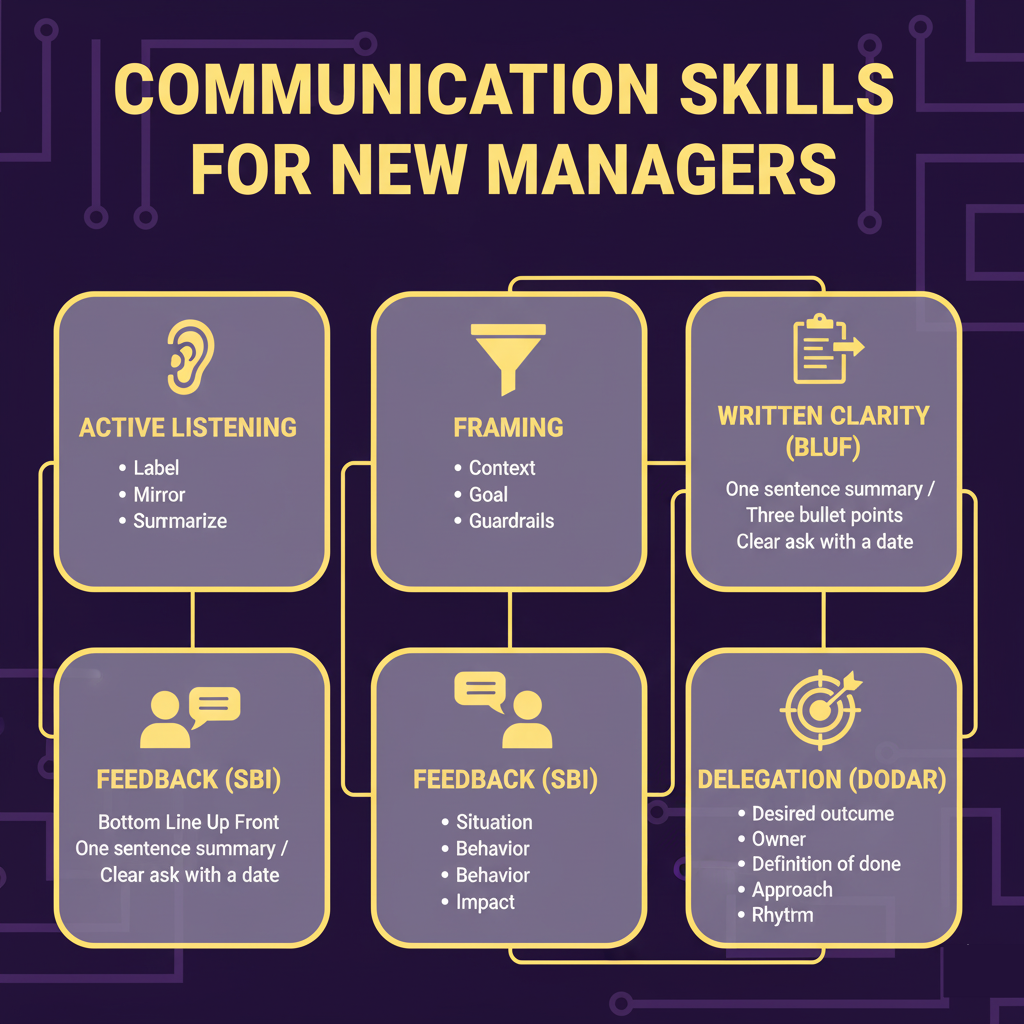
Core communication skills for managers
1) Listening that surfaces meaning
Goal: hear facts, feelings, and intent, then reflect them back so the other person feels understood and you both see the same picture.
Three micro skills:
- Label, name what you are hearing in neutral words, for example, It sounds like timing is your main worry.
- Mirror, repeat the last two or three key words, with a curious tone, for example, Blocked by security review.
- Summarize, close the loop, for example, So we agree the blocker is the security review, you own the doc, and I will escalate by Thursday.
External resource: practical primers on active listening and tactical empathy, see CNVC, Nonviolent Communication and Radical Candor.
2) Framing that aligns people quickly
Teams do not need every detail, they need a frame that says why this matters, what good looks like, and what tradeoffs we accept.
Use the Context, Goal, Guardrails mini brief:
- Context, what happened, who is involved.
- Goal, the outcome or metric.
- Guardrails [time, scope, quality], what you will accept and what you will not.
3) Written clarity for async work
Write to be skimmed. Lead with the bottom line, then provide detail for readers who need it.
Use BLUF [Bottom Line Up Front]: one sentence summary, three bullet points, clear ask with a date.
External resource: BLUF guidance, see the Army University Press primer on BLUF at the Military Review site, helpful for concise business writing, Army University Press, BLUF.
4) Feedback that builds performance and safety
Use a simple, behavior based pattern to avoid debates about intent.
SBI [Situation, Behavior, Impact]:
- Situation, when and where.
- Behavior, what I observed, no judgment words.
- Impact, the effect on people, timeline, or quality.
Wrap with a question, What will you try next time.
External resource: a clear overview of psychological safety and its link to learning, see Amy Edmondson’s work and summaries, for example her TED material and articles, or introductory explainers.
5) Delegation that sticks
Clarify the task and ownership, agree on the first visible milestone, then set the default check in.
Use DODAR [Desired outcome, Owner, Definition of done, Approach, Rhythm].
Practice drills to build communication skills for managers
These are short, repeatable, and team friendly. Run one drill per week for four weeks.
Drill A, The Listening Loop, 12 minutes, 2 people
Goal: capture facts and feelings accurately, reduce rework.
Setup: pair up. Person 1 shares a real work issue for 2 minutes.
Steps
- Person 2 listens, no notes until the end, then gives a 45 second summary using label, mirror, summarize.
- Person 1 rates accuracy 1 to 5 and adds missing details for 1 minute.
- Switch roles and repeat.
Watch for: advice giving too early, vague summaries, missing feelings that drive decisions.
Debrief questions
- What did you think you heard that was wrong.
- Which phrase made your partner feel most understood.
Drill B, BLUF in 5 sentences, 10 minutes, solo or group
Goal: write a crisp update people can act on.
Template
- Bottom line, the decision or risk.
- Three bullets, evidence or options.
- Ask with date, what you need and by when.
Steps - Pick a real topic, status or decision.
- Write the five sentences, no qualifiers, use numbers.
- Swap with a peer, can they restate your ask in one line.
Watch for: hedging words, passive voice, undefined owners.
External resource: writing structure examples and decision memos, see Manager Tools for practical casts on updates and one on ones.
Drill C, SBI feedback reps, 15 minutes, 3 people
Goal: give behavior based feedback without defensiveness.
Steps
- Person A shares a short scenario, true or fictional.
- Person B gives feedback using SBI, then asks, What will you try next time.
- Person C scores clarity 1 to 5 and suggests crisper behavior words.
- Rotate roles.
Variations: do one round for reinforcing feedback, one for redirecting feedback.
Watch for: intent statements, labels like careless, always, never.
Drill D, Delegation contract, 15 minutes, 2 to 3 people
Goal: translate a task into an agreement that survives calendar chaos.
Steps
- Owner explains the task for 60 seconds.
- Manager and owner fill DODAR together, one line per item.
- Agree on a first visible milestone and a default check in cadence.
Definition of done checklist
- Observable result or artifact is named.
- Quality bar is stated with an example.
- Risks and dependencies are listed.
Drill E, Meeting frame and close, 12 minutes, team
Goal: open meetings with alignment, close with action.
Steps
- Before the meeting, write a three line frame, Context, Goal, Guardrails.
- In the first minute, read the frame, then ask, what is missing.
- In the last two minutes, capture owners and dates, agree what to share and where.
Watch for: vague goals like discuss, no clear next step or owner.
A simple debrief you can run every Friday
Use this 10 minute debrief to turn drills into habits.
- Signal [1 minute], pick one signal that shows progress, for example, fewer reopen comments, faster approvals, clearer owners in tickets.
- Wins [2 minutes], one example of good communication this week, name the behavior, keep it specific.
- Miss [2 minutes], one communication miss, state the impact, no blame.
- Adjustment [3 minutes], one change to try next week, for example, BLUF for all weekly updates, SBI used in all feedback this week.
- Owner and reminder [2 minutes], assign the adjustment owner and set a default reminder in your team channel.
If you run team activities to reinforce these skills, build in a short, structured reflection. If you prefer a hosted session with an objective facilitator, you can run a short online game plus a debrief that connects in game behavior to work patterns. See examples and options at Superglue Games, team sessions and debriefs.
Communication skills for managers, templates you can copy
1 on 1 opener
- What feels most important this week.
- Where are you blocked and what do you need from me.
- What decision would help you move faster.
Decision frame
- Context, one paragraph.
- Options, two or three with pros and cons.
- Recommendation, one line.
- Risks and guardrails, bullets.
- Ask, who decides and by when.
Status update, BLUF format
- Bottom line, The release is at risk, two high impact bugs remain.
- Evidence, Repro rate 40 percent on iOS 17, fix ETA 48 hours, QA capacity is 2 testers.
- Ask, Approve a 48 hour slip or reduce scope, reply in this thread by 17,00 Friday.
Troubleshooting common scenarios
Stakeholder who floods you with details
- Mirror the last key words, then ask, Of these, which three facts change the decision.
- Offer to move the rest to an appendix or doc, then confirm the decision and next step.
Peer who is defensive in feedback
- Return to behavior and impact, acknowledge their intent without debating it, then shift to the next experiment, What will you try next time.
Team that waits for you to decide
- Push ownership with DODAR, ask for a recommendation in BLUF, then set a default decision time.
Remote or hybrid gaps
- Default to written frames and summaries, keep meetings for discussion and decisions, share recordings and notes.
Communication skills for managers, further learning
External resources, pick one and apply it next week.
- Amy Edmondson on psychological safety, short explainers and book links, see Wikipedia, Psychological safety and her TED talk for a quick primer.
- Radical Candor, frameworks and conversations toolkit, Radical Candor.
- Nonviolent Communication, needs based language, CNVC.
- Manager Tools, tactical casts on one on ones and feedback, Manager Tools.
- Google Project Aristotle summaries, what healthy teams share, search for re:Work summaries or start with the overview on Wikipedia, Project Aristotle.
Internal resources
- Examples of short, facilitated sessions that practice communication patterns, plus structured debriefs, Superglue Games, overview.
- If you want a hosted drill inside an online escape room or a short party platformer to practice listening, feedback, and framing under time pressure, explore options at Superglue Games.
How to put this into your week
- Pick one drill, schedule 15 minutes, run it with your team.
- Use BLUF for one update and SBI for one feedback moment.
- Run the Friday debrief and choose one adjustment.
- Keep a running page of frames, feedback notes, and decision logs. You will create team memory and reduce repeated conversations.
If you want a ready made, high energy way to practice, with a neutral facilitator and an automatic debrief, you can host a short session that blends a game and a discussion. It keeps things safe and focused, and it creates artifacts you can share with your leadership team, see options at Superglue Games.