Team development isn’t a bonus, it’s the core of learning

Team development, why it works according to research
Teams learn faster when it is safe to speak up, test ideas, and admit misses. That climate is called psychological safety, and it predicts better learning behaviors and performance on real work.
Well designed team training lifts results across knowledge, attitudes, teamwork processes, and performance. A large meta analysis found consistent, positive effects, and showed that content, team stability, and team size matter for impact.
Debriefing adds another boost. A synthesis of 46 studies found that well run debriefs improve individual and team performance by roughly 20 to 25 percent, which makes debriefs one of the highest return steps you can add to any session.
Spacing your practice matters too. Reviews of hundreds of studies show that distributing practice across sessions improves retention, which means short, repeated team reps beat a single long workshop.
Team development, formats and when to use them
Scenario simulations fit when language and judgment are the goal. Use short, realistic situations with clear decision points and immediate feedback. Best for feedback talks, stakeholder updates, and negotiation moments. See a practical primer on branching scenarios here, community.articulate.com.
Game based team sessions fit when coordination and decision speed are the goal. Use cooperative challenges on a timer where information is split across people. Best for communication under pressure, information sharing, trust, and role clarity. If you want examples, start with Superglue’s virtual escape rooms and hosted titles.
Team development, design principles that increase transfer
- Target one behavior per session, for example explicit goal checks or concise turns. Transfer improves when people learn general rules, not just scripts.
- Create real pressure with time limits, partial information, and visible tradeoffs, then let the team decide.
- Give immediate feedback during scenarios through consequences of choices, and during games through facilitator cues, then lock learning with a short debrief. Debrief quality predicts how much carries back to work.
- Space the reps across weeks. Short, repeated runs beat a one off event for retention.
Team development, a 60 minute plan you can run this month
- 0 to 5, set the practice goal and name roles, facilitator and timekeeper
- 5 to 35, run a cooperative game, call time every 10 minutes, log clues and decisions in a shared doc
- 35 to 50, run a micro scenario on the same theme, two or three decisions with immediate feedback
- 50 to 60, debrief with three prompts, what helped, what slowed us, what we will try, then record one process change and one behavior to try with an owner and a date
Want a hosted version with guided debriefs, see Spirit Speak and SeaBreeze, both built for practice under pressure.
Team development, measurement leaders will accept
Pick a few leading indicators you can see during the session, plus one follow up check.
- In games, time to first decision, number of explicit goal checks, number of risk flags
- In scenarios, rubric score on attempt two, one phrase each person will try in a real conversation
- After two weeks, ask one question, did we keep, tweak, or drop the change
Debriefs convert these signals into action, which is why they correlate with better performance.
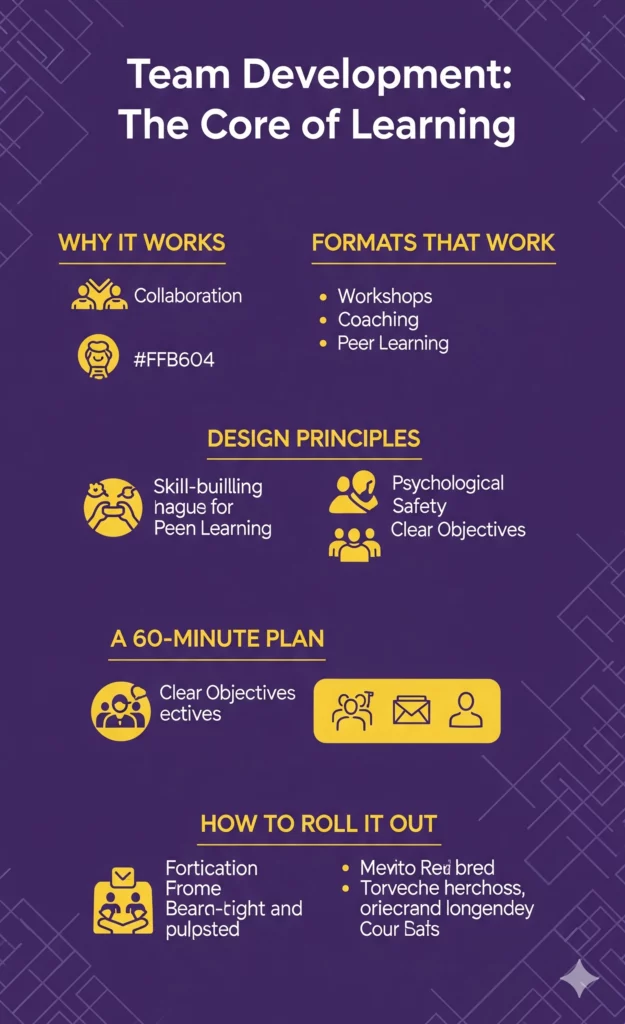
Team development, managers make it stick
Give managers a simple playbook. Observe with one lens, for example goal clarity or turn taking. Ask one prompt, what will you try in next week’s meeting. Share one update at the next check in. If you want ideas for short drills that managers can run, see Superglue’s practice guides.
Team development, how to roll it out
- Pick one work problem to improve, for example slow decisions in planning
- Choose the primary format based on that problem, scenario or game
- Schedule a 60 minute session and a five minute follow up in two weeks
- Capture one process change and one behavior to try, assign owners
- Repeat monthly, keep the same metrics so progress is visible
Team development is not an add on, it is the engine that powers learning. The research is clear on the ingredients, a climate where people can speak up, structured team practice, short debriefs, and spaced reps. Do that, and you will see faster learning and better work.