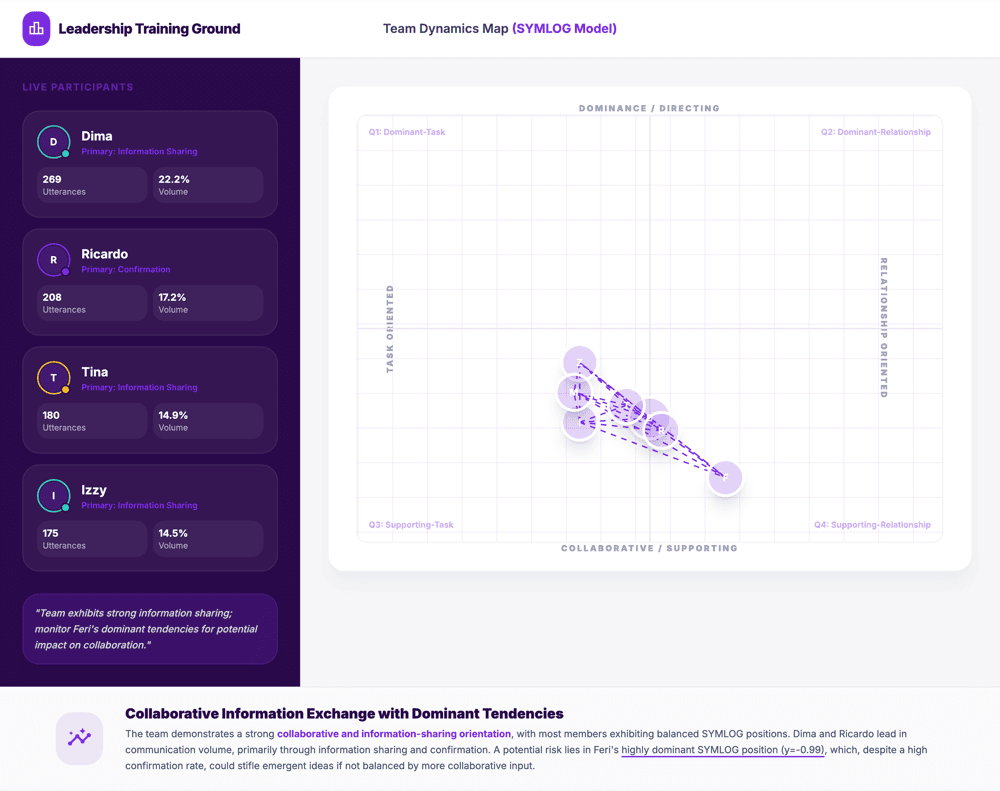
Team Dynamics Map
Positions every player on task-vs-relationship and collaborative-vs-dominant axes: interaction patterns, roles and balance.

Psychological safety is behavior: who speaks up, who challenges, how mistakes get handled. This kit observes it in a game instead of asking about it in a survey.
AI that reads the room, not the transcript.
Every game below is tagged for this assessment because its mechanics surface the behavior; the note under each one says why. Pick one main exercise per session, and the kit's report bundle rides along through checkout.
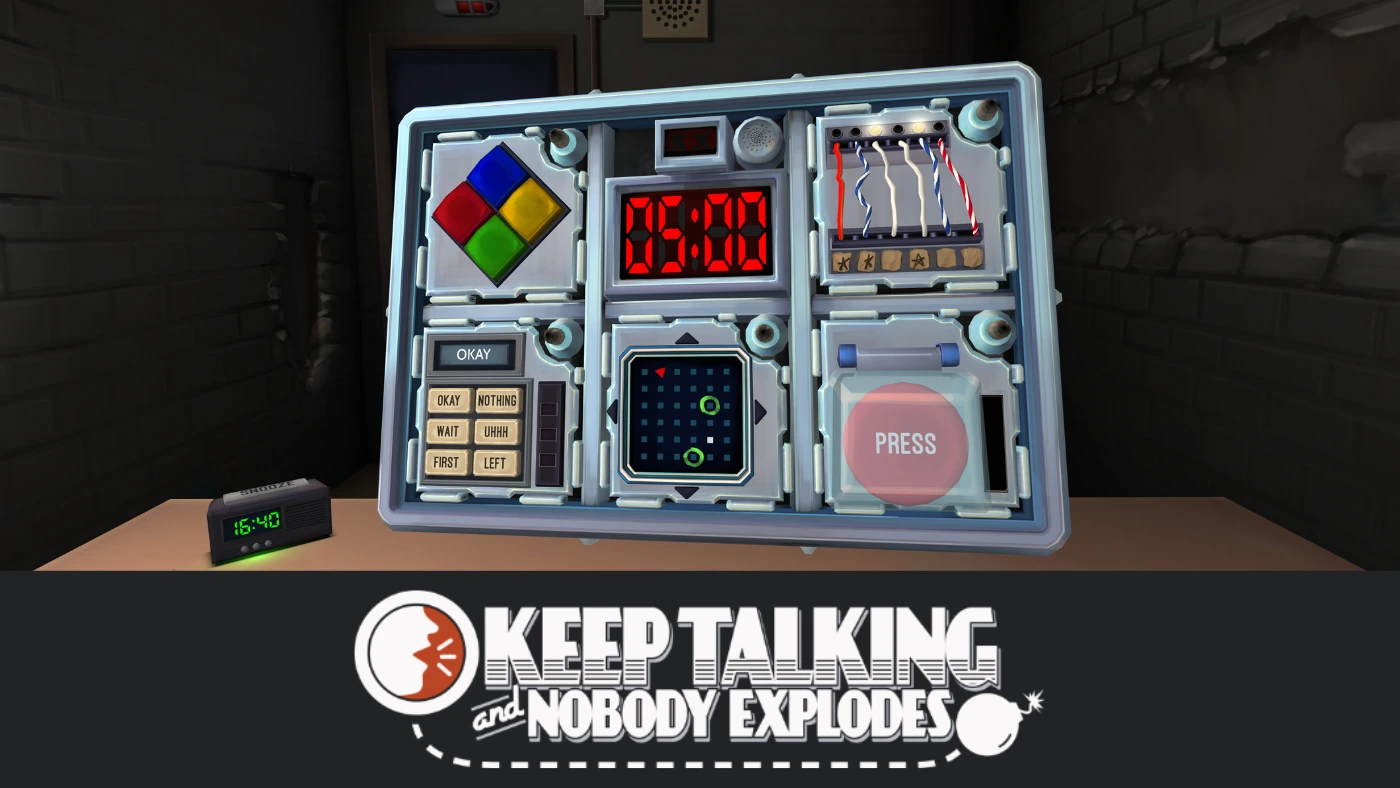 $30 KTANE Asymmetric information by design: the person with the manual has to speak up, and everyone else has to listen.
  $30 Ronin Realm Split-team play: quiet voices hold key pieces, and the group's reaction to mistakes is out in the open.
 Free with an account. Run it as the opener of the same call, or let a client try the format before the assessed session.
Built from what the AI observed during play and delivered by email about 5 minutes after the session ends, as HTML ready for your client deck. Consent first, always: the bot announces itself, and the report is a mirror for the team, never a dossier for the boss.
Positions every player on task-vs-relationship and collaborative-vs-dominant axes: interaction patterns, roles and balance.
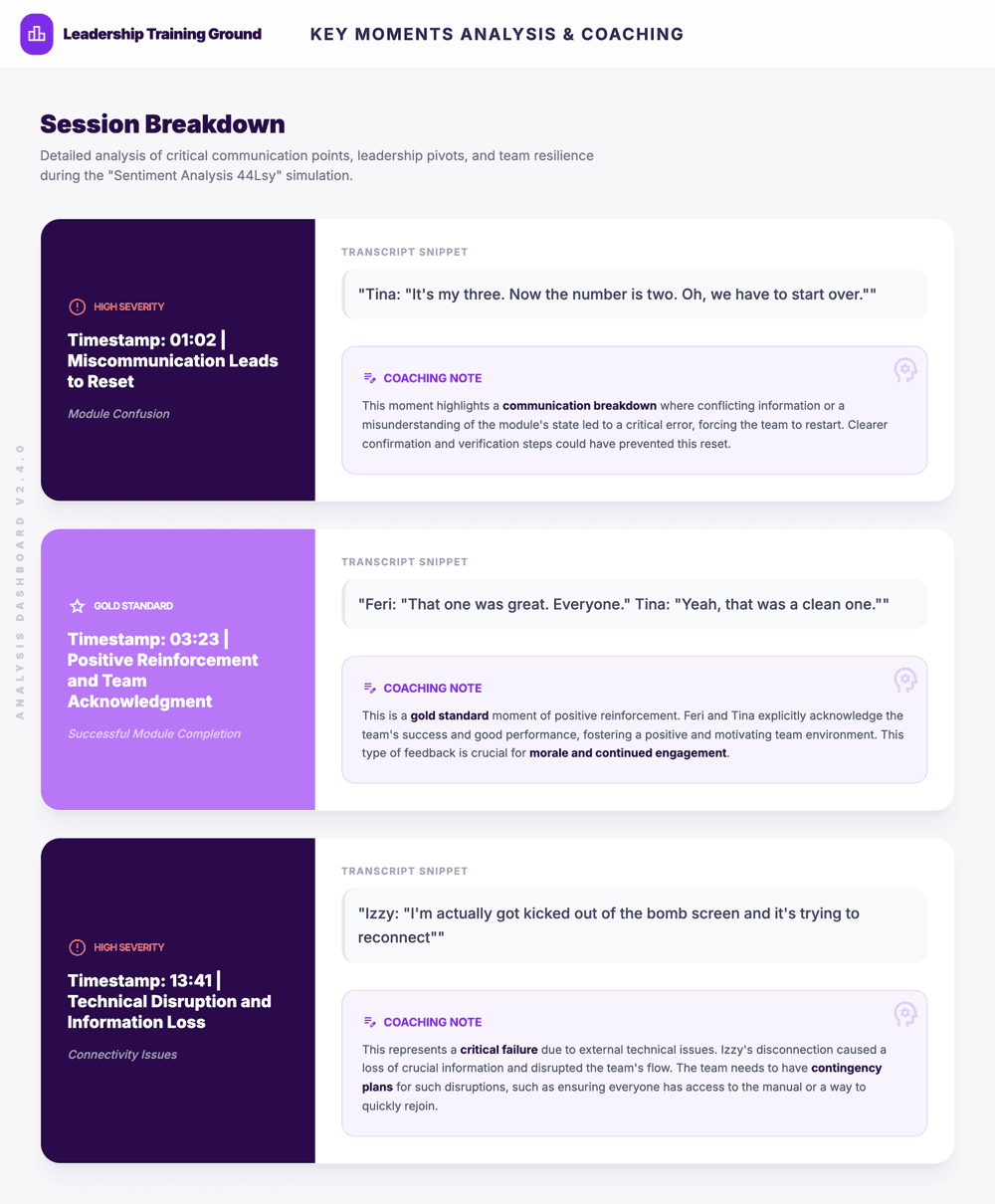
The pivotal exchanges of the session, timestamped and annotated for the debrief: failures, recoveries and gold-standard moments.
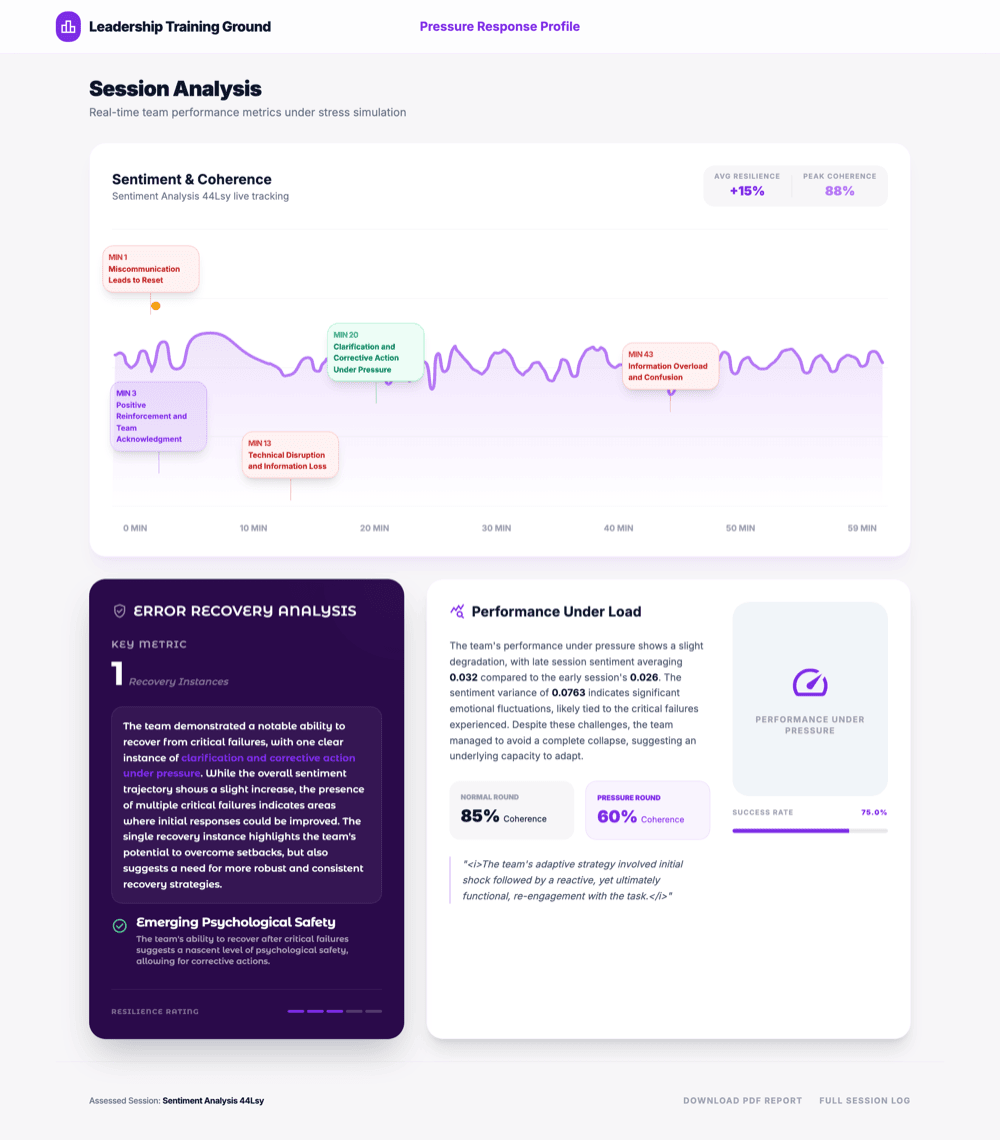
How each player responded when the clock and stakes ramped up, with a session sentiment timeline and error-recovery reads.
Partners white-label the whole reporting layer: your logo, your colors, your bot name. The client sees your practice, not our stack.
Customizable games take client-specific content: dilemmas written for their org, word lists from their domain. Your AI assistant can theme a session in one prompt.
The Key Moments cards are built for the debrief: timestamped exchanges you can put on screen and ask "what was happening here?" No slide-writing the night before.
| Survey-based instruments | This kit | |
|---|---|---|
| How the data is produced | A short survey asks people to self-rate how safe they feel | A game engineers moments where speaking up matters, and the report shows who did |
| The core problem | People who feel unsafe are the least likely to say so on a form | Participation balance, interruptions and challenges are visible in the play itself |
| Typical price | Around $12 per person, behind certified-practitioner programs from ~$2,195 | $50 per kit session (up to ~10 players): game + report bundle, $10 off the separate prices |
| Certification required | Certification programs gate the debrief | None. Ever. |
| What the team remembers | Another survey link in the inbox | The round where the quiet one saved the run |
Vendor prices are published list prices at the time of writing. All trademarks belong to their owners; Superglue is not affiliated with or endorsed by any instrument vendor named on this site.
By engineering the moments that matter. In KTANE, one person sees the bomb and everyone else holds the manual. The session only works if the people with information speak up and the group listens. The reports describe what was observable: who participated, who challenged, what happened after mistakes.
The reports describe observed session behavior; they are a development mirror, not a clinical instrument. That is a deliberate scope: observable behaviors like airtime, interruptions, challenges and recovery, rather than inferred traits.
Three reports: a Team Dynamics Map, a Key Moments Analysis of the pivotal exchanges, and a Pressure Response Profile that reads how each player handled the clock and how the group recovered from errors.
No. Superglue makes game-based team assessments for team development — not candidate screening. The team plays together as a group; nobody is tested alone against a machine, and reports are never pass/fail.
Always. The report bot announces itself when it joins the call, and anyone can send it away with a chat message. Reports are written as a mirror for the team, not a dossier for management.
Nothing. Games run in the browser from one shared link, and the report bot joins the Zoom, Meet or Teams call you already scheduled. Reports arrive by email about 5 minutes after the session ends.