
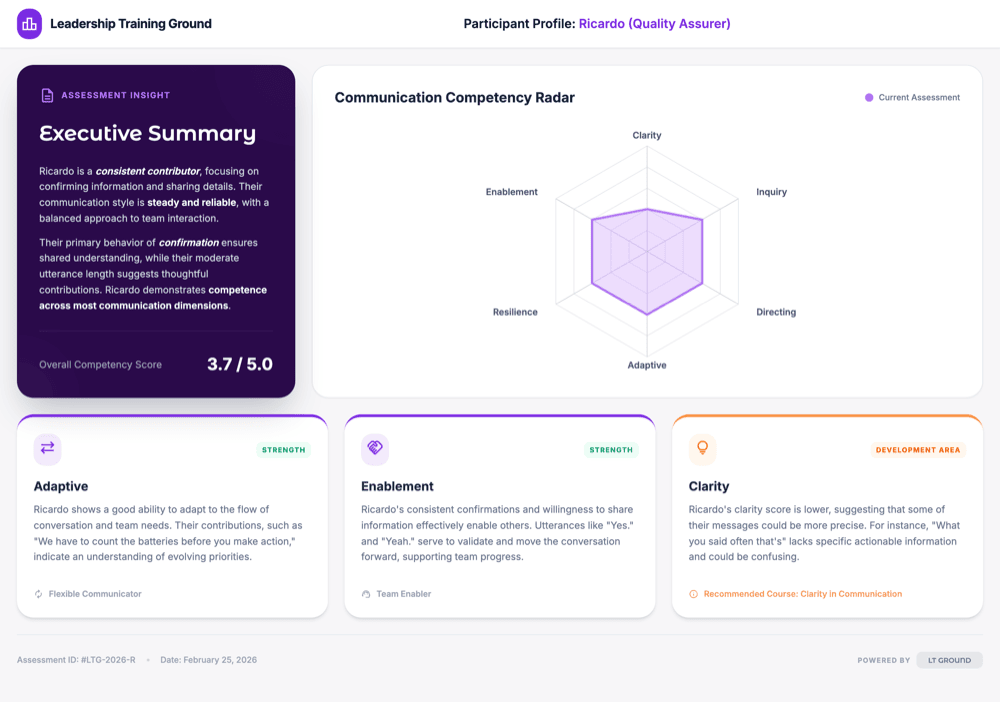
Individual Communication Profile
A per-player communication breakdown scored across six competencies, radar chart included.

How information moves through your team and where it collides under pressure. Observed in play, with a communication profile for every player.
AI that reads the room, not the transcript.
Every game below is tagged for this assessment because its mechanics surface the behavior; the note under each one says why. Pick one main exercise per session, and the kit's report bundle rides along through checkout.
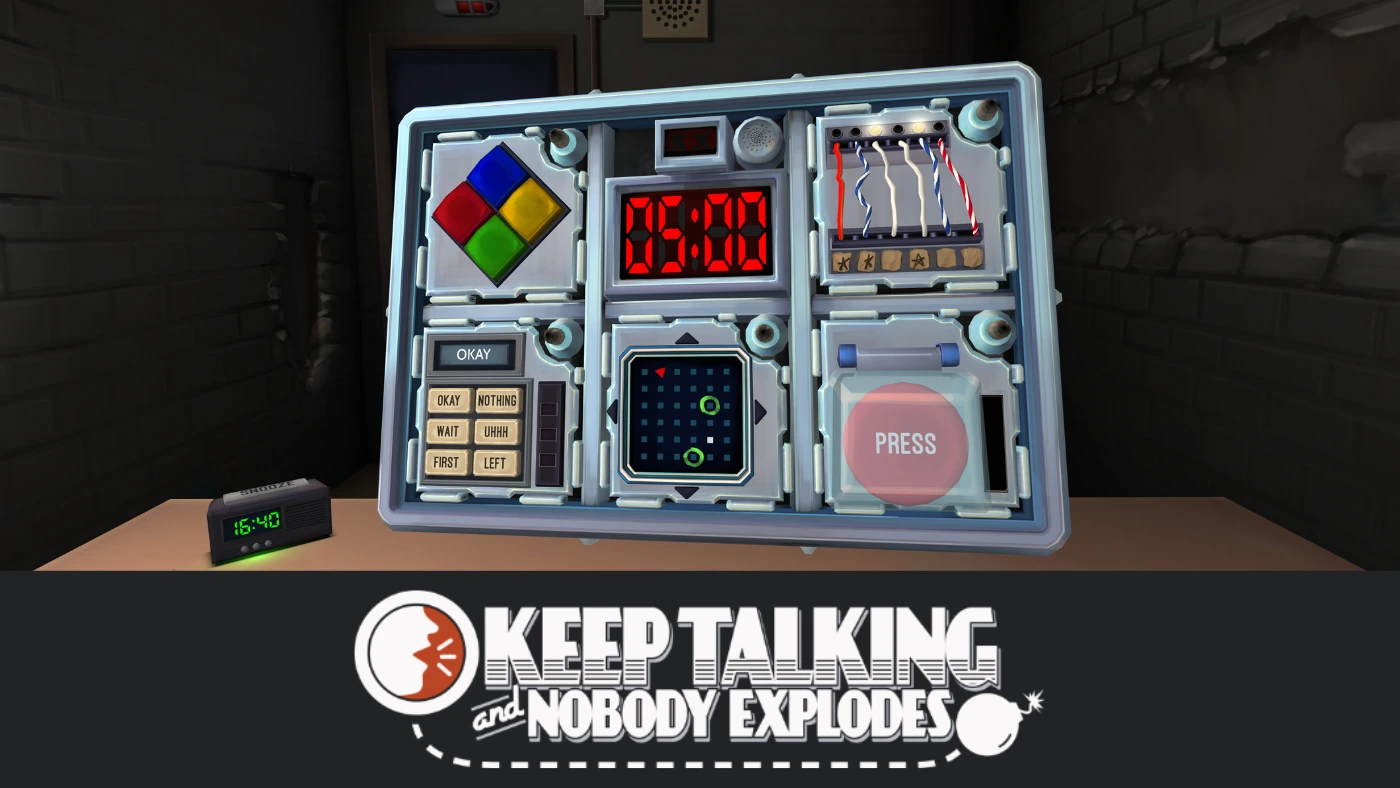 $30 KTANE Asymmetric information by design: the person with the manual has to speak up, and everyone else has to listen.
  $30 Spirit Speak One-way communication constraints: precision speaking and real listening decide the run.
  $30 Backrooms Escape Limited sightlines: progress moves exactly as fast as information does.
  $30 Mind the Generation Gap Built around perspective gaps: the puzzles only yield when different viewpoints get voiced.
 Free with an account. Run it as the opener of the same call, or let a client try the format before the assessed session.
Built from what the AI observed during play and delivered by email about 5 minutes after the session ends, as HTML ready for your client deck. Consent first, always: the bot announces itself, and the report is a mirror for the team, never a dossier for the boss.
A per-player communication breakdown scored across six competencies, radar chart included.
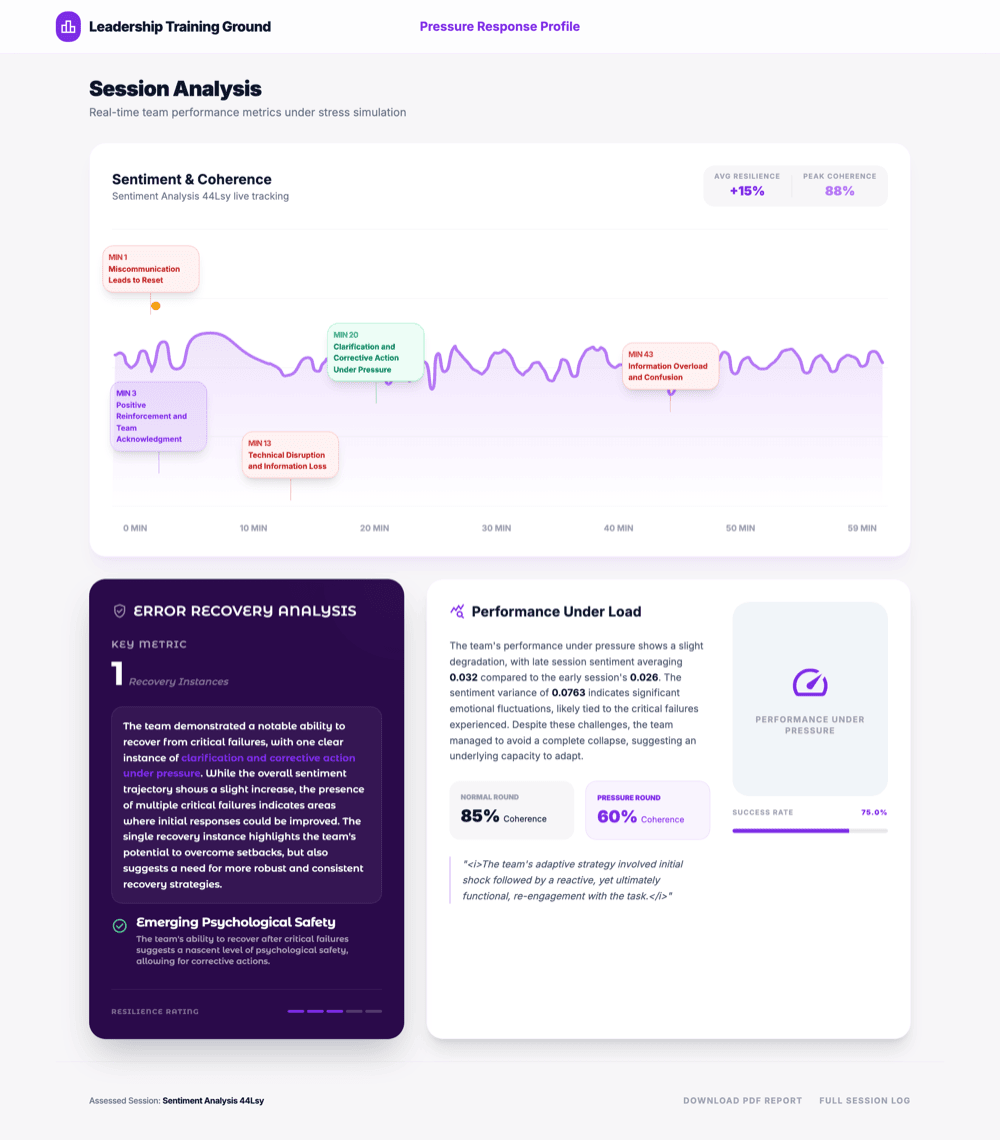
How each player responded when the clock and stakes ramped up, with a session sentiment timeline and error-recovery reads.
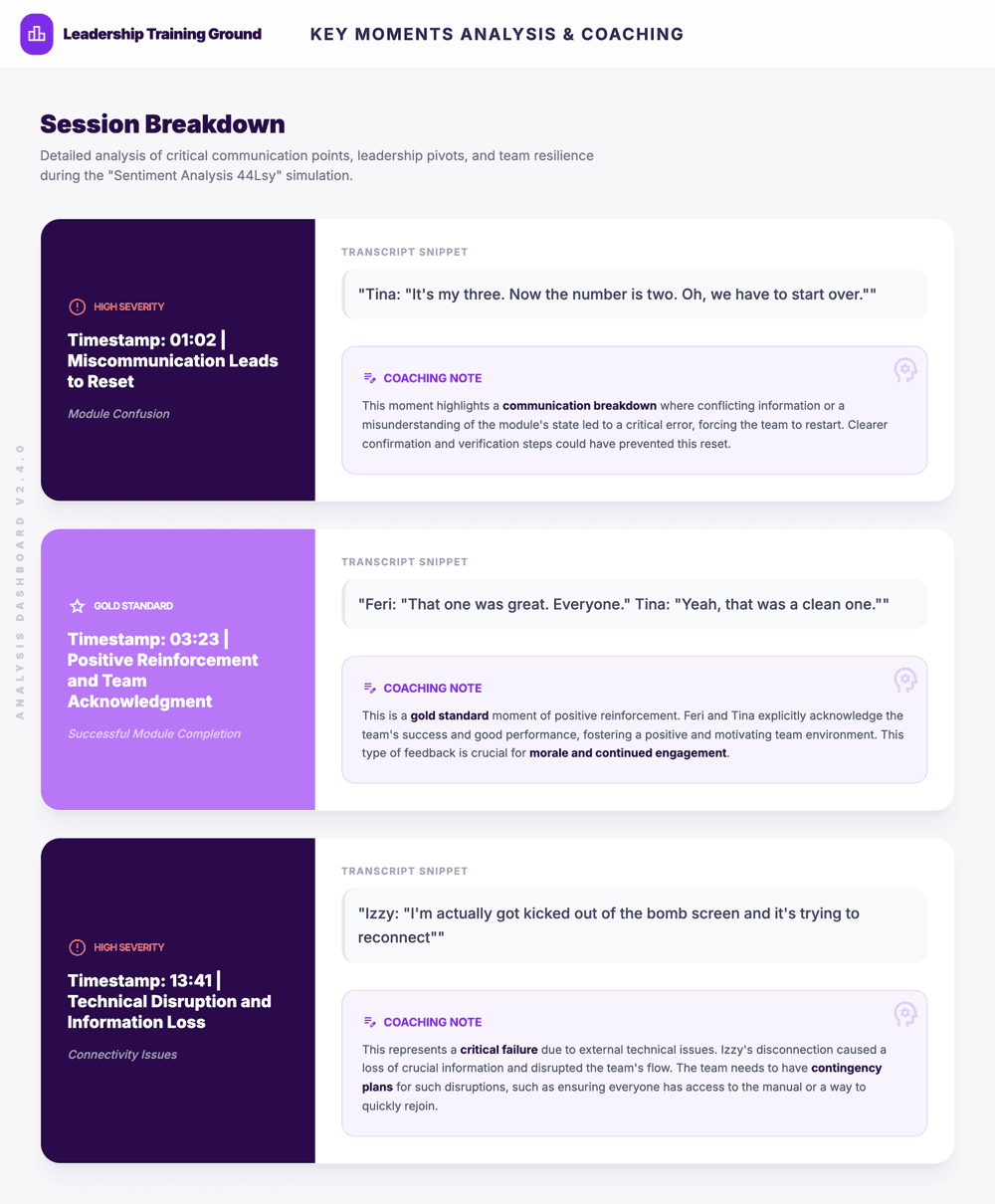
The pivotal exchanges of the session, timestamped and annotated for the debrief: failures, recoveries and gold-standard moments.
Partners white-label the whole reporting layer: your logo, your colors, your bot name. The client sees your practice, not our stack.
Customizable games take client-specific content: dilemmas written for their org, word lists from their domain. Your AI assistant can theme a session in one prompt.
The Key Moments cards are built for the debrief: timestamped exchanges you can put on screen and ask "what was happening here?" No slide-writing the night before.
| Survey-based instruments | This kit | |
|---|---|---|
| How the data is produced | A self-scored questionnaire assigns each person a conflict style | The game creates communication pressure; styles are read from what people actually did |
| The exercise and the instrument | Sold separately: a game kit from one vendor, per-head forms from another | The game is the instrument: one session produces both the experience and the data |
| Typical price | Around $45 per person for the questionnaire, plus activity kits from ~$300 | $50 per kit session (up to ~10 players): game + report bundle, $10 off the separate prices |
| Certification required | Varies; the best-known instruments gate their workshop materials | None. Ever. |
| Repeatability | The same questionnaire gives the same answers | Different games, same instrument: re-run it next quarter without staleness |
Vendor prices are published list prices at the time of writing. All trademarks belong to their owners; Superglue is not affiliated with or endorsed by any instrument vendor named on this site.
How information moves: who broadcasts, who listens, who builds on others, who goes quiet, and how disagreement gets raised and resolved when the clock is running. Every player gets an Individual Communication Profile, and the Key Moments Analysis pins the exchanges that deserve a debrief.
A questionnaire records how people describe their style. A communication-constrained game (one voice channel, split information, time pressure) records the style itself. The two often disagree, and the difference is usually where the coaching value sits.
No. Superglue makes game-based team assessments for team development — not candidate screening. The team plays together as a group; nobody is tested alone against a machine, and reports are never pass/fail.
Always. The report bot announces itself when it joins the call, and anyone can send it away with a chat message. Reports are written as a mirror for the team, not a dossier for management.
Nothing. Games run in the browser from one shared link, and the report bot joins the Zoom, Meet or Teams call you already scheduled. Reports arrive by email about 5 minutes after the session ends.